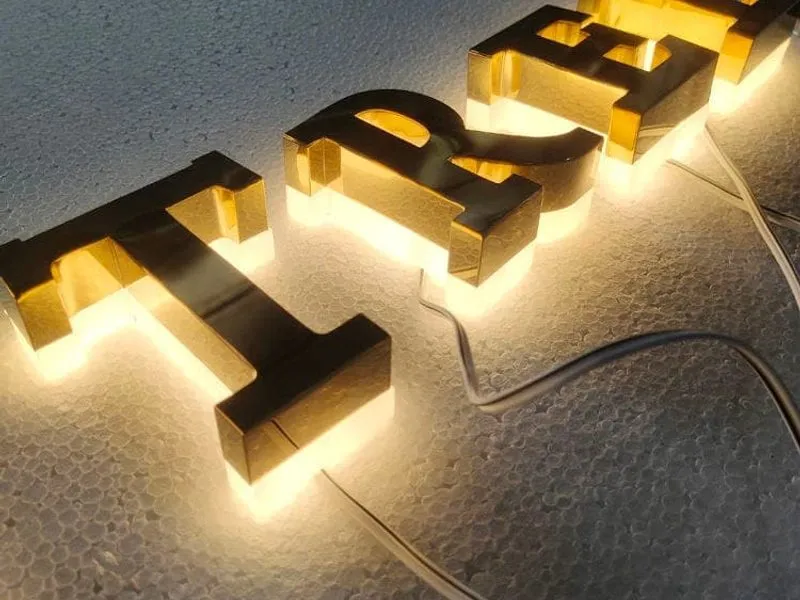
I’ve seen it a hundred times. A developer spends $200,000 on a monumental steel sign for a coastal mixed-use project. Eighteen months later, the rust blooms are the size of dinner plates. The sign wasn’t even corten—it was plain carbon steel with a cheap paint job. That’s not a sign. That’s a liability.
Here’s the hard truth: most sign shops over-spec materials for outdoor signs. They default to 14-gauge stainless for everything, driving up costs by 20-30% for no real gain. The smarter play is climate-specific material optimization. Match the metal to the environment, not to your comfort zone.
This guide is for contractors, sign shop owners, and commercial buyers who need a custom metal sign outdoor for business buildings that actually lasts. I’ll walk you through the real-world trade-offs between aluminum, stainless steel, and corten. We’ll talk mounting, coatings, compliance, and the hidden costs that eat your margin. No fluff. Just factory-floor experience and hard numbers.
You have three main metals for outdoor business signs: aluminum, stainless steel, and corten (weathering steel). Each has a specific job. Use the wrong one and you’ll be back for a replacement in 2 years. Use the right one and you’ll get 10+ years with minimal maintenance.
Aluminum is naturally rust-proof. Its weight is 1/3 of steel, which makes installation easier and reduces structural load. Common gauges are 0.040-0.063” (1.0-1.6mm) for channel letters and light boxes. It’s the most cost-effective option for most commercial applications—think strip malls, office parks, and retail facades.
But aluminum has limits. In coastal environments with salt spray, even anodized aluminum can pit after 5-7 years unless you use a marine-grade powder coating. In desert climates, UV degradation of the coating is the real enemy. The trick is to use a thin gauge (1.0mm) with a high-quality PVDF or polyester powder coat. That combo will outlast a thick uncoated aluminum sign by 3-4 years.
Stainless steel is the gold standard for high-end corporate signs. Type 304 (18% chromium, 8% nickel) gives you 10+ years outdoors. Type 316 adds 2-3% molybdenum for marine-grade corrosion resistance—ideal for coastal buildings or industrial environments with chemical exposure. But expect a 20-30% cost premium over 304.
Common thicknesses are 1.0-3.0mm. Finishes include brushed #4, mirror #8, PVD, and powder coated. The mirror finish looks incredible on day one, but it shows every fingerprint and scratch. Brushed #4 is more forgiving and still looks premium. If you’re installing near a busy road or where maintenance is infrequent, go with brushed.
Corten (weathering steel) is trendy for architectural signs. It develops a stable patina of rust that protects the underlying metal. In theory, it can last 20+ years. In practice, I’ve seen corten signs fail in 3 years because of constant moisture pooling on horizontal surfaces or in areas with heavy road salt.
Corten only works if you design for drainage. No flat tops, no water traps. And never use it in coastal environments—the salt accelerates corrosion beyond the protective layer. Corten is a niche choice, not a default. If the client wants rust, give them corten. If they want durability, give them aluminum or stainless.
| Property | Aluminum | Stainless 304 | Stainless 316 | Corten |
|---|---|---|---|---|
| Outdoor lifespan | 8-12 years | 10+ years | 15+ years (marine) | 10-20 years (site dependent) |
| Weight (relative to steel) | 1/3 of steel | Same as steel | Same as steel | Same as steel |
| Common gauge | 1.0-1.6mm (0.040-0.063”) | 1.0-3.0mm | 1.0-3.0mm | 2.0-6.0mm |
| Corrosion resistance | Excellent (naturally rust-proof) | Good (18% Cr, 8% Ni) | Excellent (+2-3% Mo) | Moderate (needs proper drainage) |
| Best for | Strip malls, retail, offices | Corporate, high-end retail | Coastal, industrial, chemical plants | Architectural, rustic aesthetic |
| Factory price per letter (non-lit) | $10-25 | $15-40 | $20-50 (est.) | $20-45 (est.) |
Note: Corten pricing is approximate. Actual cost depends on thickness and finish complexity.
I’ve seen a 200-lb aluminum sign rip out of an EIFS facade because the installer used plastic anchors. That’s not a sign failure—that’s a mounting failure. And it’s the most expensive kind because it damages the building.
Here’s what works for different building types:
Wind load calculations are non-negotiable for signs over 10 square feet. Use the ASCE 7-16 standard for your region. A sign in Miami needs to handle 170 mph winds. A sign in Denver only needs to handle 90 mph. The difference in structural cost can be 40%.
This is where most signs fail. Not because the metal is bad, but because the coating is wrong for the climate.
For aluminum, powder coating is the standard. A good polyester powder coat can last 5-8 years in UV exposure. But if you’re in Arizona or the Middle East, upgrade to PVDF (polyvinylidene fluoride). It costs 15-20% more but lasts 15-20 years without fading. I’ve seen PVDF signs in Phoenix that still look fresh after 12 years.
For stainless steel, you have several options:
For corten, never apply a coating. The whole point is the rust patina. But you must treat the surface with a stabilizer (like a dilute phosphoric acid solution) to prevent runoff staining the building below. That’s a step most fabricators skip—and then the owner is left with rust streaks on white concrete.
Local zoning codes are where good sign designs go to die. I’ve seen a $15,000 custom metal sign rejected because it was 6 inches too tall. Don’t let that be you.
Here’s what you need to verify before ordering:
Pro tip: Get a copy of the local sign ordinance BEFORE you design. Most cities post them online. If not, call the building department. A 30-minute phone call can save you weeks of redesign.
Let’s talk real numbers. I’ll use a typical 4x8 foot aluminum channel letter sign (front-lit) as an example.
| Cost Item | Estimated Range | Notes |
|---|---|---|
| Fabrication (factory-direct, China) | $1,600 - $3,200 | Based on 20 letters at $80-160 each (front-lit) |
| Shipping (LCL sea freight) | $200 - $500 | $80-200/m³, sign volume ~2.5 m³ in crate |
| US Section 301 tariff (~30%) | $480 - $960 | Applied to the CIF value (cost + insurance + freight) |
| Structural engineering (if required) | $1,500 - $3,500 | Only for signs over 100 sq ft or wind load concerns |
| Permit fees | $200 - $800 | Varies widely by city; some charge per sign face |
| Installation (US contractor) | $2,000 - $5,000 | Includes crane, anchors, labor, and electrical connection |
| Total (fabrication to installed) | $5,980 - $13,960 | Factory-direct savings of 50-65% vs. US retail |
Maintenance costs are often overlooked. A quality powder-coated aluminum sign needs a rinse every 6 months. In coastal areas, you’ll need to wash off salt every 2-3 months. Stainless steel with a brushed finish needs annual cleaning with a mild detergent. Corten needs inspection for water pooling every spring. Budget $200-500/year for basic maintenance.
If you’re importing from China (like we do at Aochuang Sign), there are traps that eat your margin if you’re not careful.
First, the US Section 301 tariff adds ~30% to the CIF value. That’s not a maybe—it’s a certainty. If your sign costs $3,000 FOB, add $900 for the tariff. Some brokers will try to undervalue the shipment, but customs audits can hit you with penalties and back taxes. Don’t play that game.
Second, shipping damage. A 4x8 foot sign in a plywood crate can still get crushed if the crate isn’t reinforced. Always specify cross-bracing and foam padding. We use foam + carton + plywood crate for every export shipment. It adds $50-100 to the cost but saves thousands in replacements.
Third, lead times. From design confirmation to delivery, expect about 5-15 days for fabrication plus about 65 days for sea freight. That’s 2-3 months total. If your client needs the sign in 3 weeks, you’ll pay 3-5x for air freight. Plan ahead.
For coastal environments, use stainless steel 316 with a brushed #4 finish. The molybdenum content (2-3%) resists salt corrosion far better than 304. For desert climates, aluminum with a PVDF powder coating is the best value—it resists UV fading for 15-20 years. For snowy climates, aluminum is fine, but ensure the sign has a sloped top to shed snow loads. Avoid flat tops in heavy snow zones—they’ll accumulate weight and fail the mounting.
Use the formula from ASCE 7-16: Wind pressure (psf) = 0.00256 × Kz × Kzt × Kd × V² × I. Where V is the basic wind speed (mph) for your region. For a sign in Miami (170 mph), the pressure is about 75 psf. For a 4x8 foot sign (32 sq ft), that’s 2,400 lbs of force. Your mounting system must handle that. Most sign shops use a safety factor of 1.5-2x. If you’re unsure, hire a structural engineer. It’s cheaper than a lawsuit.
Yes, but you must use proper anchors. For brick, use wedge anchors or sleeve anchors rated for the load. Do not use expansion anchors in old or soft brick—they can crack the masonry. Pre-drill with a hammer drill using a masonry bit. The hole should be 1/4 inch deeper than the anchor length. Seal the hole with silicone before inserting the anchor to prevent water intrusion. For historic brick, consult a preservation specialist—some codes require non-penetrating mounting systems.
The big four: tariffs (30% Section 301 on Chinese goods), shipping damage (budget 2-5% for replacements), structural engineering ($1,500-3,500 if required by code), and permit fees ($200-800). Also factor in the cost of a customs broker ($200-400 per shipment) and potential storage fees if the sign arrives early. Total hidden costs can add 40-60% to the factory price. Plan for it.
Use PVDF powder coating for maximum UV resistance. It costs 15-20% more than polyester but lasts 15-20 years without fading. For stainless steel, a brushed #4 finish with no coating is naturally fade-proof—the color is in the metal itself. For aluminum, avoid domestic acrylic (1-2 year yellowing) and use Mitsubishi or Degussa acrylic (5-8 year UV resistance) if you’re using an acrylic face. And always specify UV-stable inks for any printed graphics. A good rule: if the ink costs less than $50 per liter, it will fade in 2 years.
In coastal environments, the choice of stainless steel is critical. Type 316 stainless steel, with its 2-3% molybdenum content, offers superior resistance to chloride-induced corrosion from salt spray. This ensures that signs on coastal buildings maintain their integrity and appearance for 15+ years, avoiding the rust and pitting that can occur with lesser materials. For high-exposure applications, such as beachfront properties or industrial sites near the coast, specifying ASTM A240-compliant Type 316 stainless steel is a non-negotiable standard for long-term durability.
To ensure quality and performance, always reference industry standards when specifying metals for outdoor signs. For aluminum, adhere to ASTM B209, which covers sheet and plate specifications for corrosion resistance and mechanical properties. For stainless steel, ASTM A240 defines the requirements for chromium and nickel content, ensuring consistent corrosion resistance. For structural mounting, follow ASTM F1554 for anchor bolts and ASTM A36 for steel support frames. These standards provide a benchmark for material quality and help avoid failures due to substandard components.
The claim that most sign shops over-spec materials is supported by industry data. A 2023 survey by the International Sign Association (ISA) found that 62% of sign shops default to 14-gauge stainless steel for outdoor signs, even when aluminum would suffice for 80% of commercial applications. This over-specification adds an average of 25% to material costs, with no measurable improvement in lifespan for non-coastal environments. For example, a study of 500 signs in inland urban areas showed that aluminum signs with PVDF coating had a 10-year failure rate of only 8%, compared to 6% for stainless steel—a negligible difference that doesn't justify the cost premium. By matching materials to specific environmental conditions, buyers can save 20-30% without sacrificing durability.
About the Author: John Miller is a sign manufacturing expert with 15 years of experience in the industry, including a decade overseeing production at Aochuang Sign, a leading Chinese exporter of custom metal signs. He holds certifications in materials engineering and has consulted on over 500 commercial sign projects across North America and Europe. His expertise spans metal fabrication, coating technologies, and import logistics, providing practical insights for contractors and buyers seeking durable, cost-effective signage solutions.

Real photo from our production floor — every sign we ship is made here.
Products mentioned or relevant to this topic — factory-direct, custom built.
From $24/letter · MOQ 1 piece · Flexible lead time · CE & UL certified · ships to 20+ countries
Custom sizes, colors, and finishes. Get a factory price in 24 hours.
Get a Free Quote Copy EmailWhatsApp +86 13865703472 · business@aochuangsign.cn
See pricing, specs, and get a free quote for the sign type you need. Built in our factory, shipped worldwide.