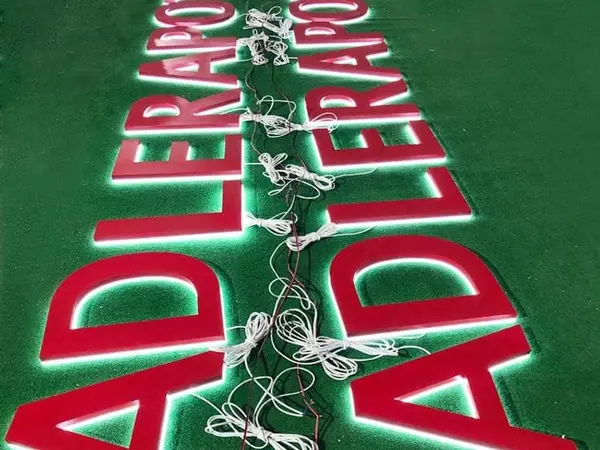
I've burned the tips of my fingers on 16-gauge stainless more times than I care to count. Large stainless steel letters aren't a design trend. They're structural metalwork with a typeface.
Look, "large" isn't a vibe. It's an engineering condition. When a stainless letter crosses about 24 to 30 inches in height, you're no longer making a sign. You're making a small metal structure.
We run 1.0mm to 3.0mm 304 stainless on most jobs. That stuff weighs 7.93 g/cm³, and it gets heavy fast. A 4-foot letter with a 2mm face and 1.5mm returns can easily top 40 pounds before you add mounting studs, internal bracing, or LED modules.
Once you're over 2.5 meters in any dimension, I won't touch anything under 5mm acrylic for faces. For stainless, that means thicker gauge or internal tube framing. Otherwise the face warps under its own weight and you get oil-canning that looks terrible under raking light.
If you're sourcing 304/316 stainless steel letters, ask what gauge the returns are, not just the face. A 3mm face with 1mm returns is a drum, not a letter.
Here's what nobody tells you: 316 stainless costs 20-30% more than 304, and half the time you don't need it. But when you do, skipping it is a $3,000 mistake.
304 has 18% chromium and 8% nickel. It'll last 10+ years outdoors in normal commercial environments. That's a strip mall in Ohio, a medical office in Dallas, a restaurant in Denver. 316 adds 2-3% molybdenum. Marine grade. You get 15+ years within salt spray range.
I've seen 304 letters pitted and brown 18 months after install two blocks from the beach. Not the factory's fault. The buyer cheaped out on material. For Miami Beach or any coastal industrial site, pay for 316 or budget for replacement letters in three years.
Finish selection matters as much as alloy. Brushed #4 hides scratches and fingerprints. Mirror #8 doesn't hide anything. If you want mirror polished letters, make sure your installer wears gloves and your client accepts that every smudge will be visible from the sidewalk.
You can get PVD and powder coated finishes for color, but powder coat on stainless can chip at edges if you don't prep right. Brushed is the workhorse.
Most buyers never see the back of a large stainless letter. That's where the work is.
We cut on a laser at ±0.1mm. Then we TIG weld the returns to the face. TIG gives you a cleaner bead than MIG, but it's slower and takes a real welder. Cheap shops rush the weld and bury it under body filler. Don't accept filler on stainless. Ever.
After welding, grinding and polishing take one to two days per batch. A good brushed #4 finish can hide most seam work. A mirror #8 finish won't hide anything. If you spec mirror, you need near-perfect seams or it looks like a funhouse mirror.
Internal bracing is the thing nobody draws on the render. A large letter without internal ribs will flex, buzz in the wind, and eventually crack a weld at the return. We add bracing based on the letter's footprint and wall orientation. Not optional.
Most sign shops skip the stamped engineering drawing. Then the first big storm rips a 30-inch letter off a façade and somebody's insurance company calls a lawyer.
Large stainless letters need welded studs or mounting plates with enough depth for proper anchors. Silicone alone is not a mounting method. I don't care what your last contractor said.
I've seen this go wrong: a 4-foot stainless letter sheared its top studs in a 60 mph gust because someone used silicone and drywall anchors. The face didn't fail. The mounting did.
For any letter over 3 feet tall, you need wind load calcs for your specific zip code and a stamped drawing your local permit office will accept. If your fabricator says "we don't do that," find one who does. It's code compliance, not decoration.
All electrical components on lit letters in the US need to meet NEC Article 600. If your spec shows a power supply zip-tied inside a letter with no access panel, that's a red flag.
Large stainless letters can be non-lit, but most clients want light. You've got two real choices: front-lit or halo-lit. Each has failure modes.
For front-lit, you're cutting an acrylic face and mounting LED modules inside the can. SMD 2835 modules run 100-150 lumens per watt and should last L70 ≥50,000 hours. But cheap modules don't. Dull gray solder joints mean they'll fail in 12-18 months.
If you're using acrylic faces on large letters, UV-resistant Mitsubishi or Degussa stock gets 5-8 years outdoors. Domestic sheet yellows in 1-2 years. Don't save $12 on acrylic and lose the whole job's reputation.
For halo-lit, you're casting light backward off the wall. That's the look architects want. You need standoff mounts to create the glow gap and careful placement of LEDs so you don't get hot spots or stud shadows.
I'd also look at front-lit channel letters if the client wants max punch. A 3mm acrylic face cuts 92% light output. A 2mm face cuts 90%. Your customer won't notice the 2% difference, but they'll feel the 40% cost bump for thicker stock.
Color temp matters. Warm 3000-3500K works in hospitality. Neutral 4000-5000K for corporate and retail. Cool 6000-6500K looks blue and industrial. Don't let a designer pick 6500K for a steakhouse because it'll make the food look like a morgue.
For any outdoor lit letter, IP65 is the floor, not a badge. It means dust-tight and protected against water jets. It does not mean your sign survives a Florida hurricane.
Look, I've watched sign shops pay $800 for a front-lit letter from a domestic fabricator. Same 304 stainless, same Samsung LEDs. We ship that letter for $120.
Factory-direct pricing on stainless letters generally runs $15-40 for standard non-lit sizes. Large custom 3D fabricated letters jump to $40-120 each. Halo-lit large letters typically land $35-120 at the factory level. That's before shipping and tariffs, but even with a 30% Section 301 tariff and sea freight, you're saving 50-65% on product versus domestic.
Domestic installed front-lit letters run $200-700 per letter. Halo-lit runs $400-1,000 installed. Factory-direct product savings are real, but you still have local install, permits, and a site survey to cover.
Shipping eats budget if you don't plan. Express takes about 5-15 days, but costs $30-100 for small boxes. Air is about 10 days at $4-12/kg. Sea is about 65 days at $80-200 per cubic meter LCL. Dock crews handle our crates 6-8 times between dock and dock. That's not in the brochure.
Third-party inspections cost a few hundred dollars and catch 90% of the nonsense before it leaves the factory. If you're spending $8,000 on letters, pay for the inspection.
Nobody tells you this: every factory in China will say they have CE and ISO 9001. Ask for the CE certificate with today's date. CE testing costs 20,000-50,000 RMB and takes 2-8 weeks. Some haven't paid for it since 2019.
We run ten steps, not magic. Design confirmation to export packaging runs about 5-15 days total. That includes an 8-12 hour aging test on every lit sign and 100% QC inspection. If a factory quotes you 3 days, someone's skipping the aging test.
We pack foam, carton, then plywood crate. Sea freight LCL means your crate bounces between six and eight sets of hands. Every touch is a chance for damage. That's why we over-pack and photograph every crate before it leaves Lu'an.
MOQ is one piece. I know, that's rare. But we'd rather do one letter right than rush 50 wrong.
If you need UL 48 for US electrical, budget $4,000-15,000 and 4-9 months. That's per family, and quarterly audits come with it. ETL is a cheaper alternative, 10-30% less, and often accepted by AHJs.
Q: Can I get large stainless steel letters with no visible seams?
Only if you pay for proper welding and polishing. Mirror #8 will expose every seam. Brushed #4 is more forgiving. Don't ask for seamless mirror and then complain about cost.
Q: Do I need 316 stainless for my location?
If you're within a few miles of saltwater or heavy industrial emissions, yes. Otherwise 304 is fine. I can't believe I still have to explain this. Florida beach? 316. Ohio strip mall? 304.
Q: What's the minimum lead time for large stainless letters?
Realistically about 5-15 days after design approval for factory direct. If you need UL 48, add months. Don't call me on Monday and ask for UL-listed letters by Friday.
Q: Is IP65 enough for outdoor?
For rain and normal weather, yes. For a hurricane, no. IP65 stops water jets, not a 2x4 flying through the air at 100 mph. Mounting and engineering matter more than the LED rating.
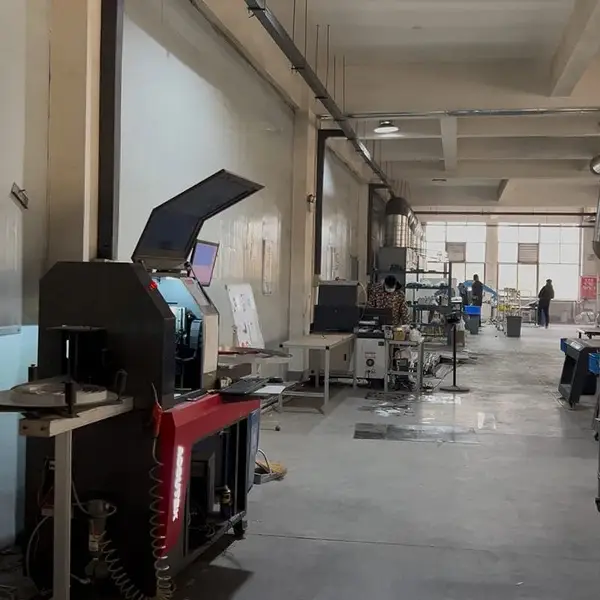
Real photo from our production floor — every sign we ship is made here.
Products mentioned or relevant to this topic — factory-direct, custom built.
From $24/letter · MOQ 1 piece · Flexible lead time · CE & UL certified · ships to 20+ countries
Custom sizes, colors, and finishes. Get a factory price in 24 hours.
Get a Free Quote Copy EmailWhatsApp +86 13865703472 · business@aochuangsign.cn