Published July 28, 2026 · Home > Blog > LED Channel Letters: The Procurement Manager’s Guide to Justifying Cost, Material Choices, and Installation That Doesn’t Drive You Crazy
Your CFO just asked, “Why can’t we just buy those light-up letters from the local sign shop for $800 each?” And you have about 90 seconds to prove you’re not wasting money. Here’s what I say back, every single time: “Because I can get the exact same Samsung LED, 304 stainless steel, 5mm acrylic letter for $120 – and it’ll still be running when the local shop’s letter is a yellow, dim mess.” That’s the conversation. Let’s break down the numbers, the materials, and the install tricks that keep my boss happy and my supply chain sane.
Editor’s note: The author has a long-term sourcing relationship with one factory-direct supplier (Aochuang) mentioned in this article. No compensation was received for this mention. Readers should always evaluate multiple suppliers—domestic and overseas—and verify certifications independently. Industry standards such as UL 48 (UL 48 for signs) and the DOE’s LED Lighting Facts program provide independent benchmarks for safety and performance.
When I crunched the numbers for our last 15-store roll-out, I ran a side-by-side comparison: domestic fabricated vs. factory-direct from Aochuang (our go‑to for the last six years). Front-lit channel letters, 3mm acrylic, 304 stainless steel returns, SMD 2835 modules. Domestic quote: $450 per letter, installed by a third‑party crew. Factory-direct: $120 per letter, plus $40 shipping via air freight (for the 10‑letter sign, that’s 400 bucks total), plus $100 for a local electrician to mount and wire. Total landed cost per letter: $120 + $4 shipping allocation + $10 installation = $134. That’s a 70% savings. Multiply by 150 letters across five stores, and you’re talking about keeping $47,400 in the budget. That’s not “saving pennies.” That’s a whole new store’s signage budget.
But CFOs care about more than the purchase price. They want total cost of ownership. LED channel letters have a meaningful advantage here. The SMD 2835 modules we use hit 100–150 lumens per watt. A typical 10‑letter sign with 200 LEDs draws about 150 watts. At $0.12/kWh, that’s $157 a year to run it 12 hours a day. A comparable neon sign would pull 400 watts minimum – $420 a year. Over a five‑year warranty period, the LED sign saves you $1,315 in electricity alone. And that’s before you factor in that the LEDs themselves are rated L70 ≥ 50,000 hours – that’s 11.4 years of 12‑hour days. Cheap modules? I’ve seen them fail in 18 months. But Samsung or Osram chips from a factory that actually runs an 8‑hour aging test? They’ll outlast the lease.
The ROI works out to a payback period of about 14 months compared to neon. After that, it’s pure savings. And if your boss asks about resale value? A well‑lit, modern sign with even illumination (90–92% light transmittance from quality acrylic) increases curb appeal. I’ve watched a dim, yellowed sign cost a landlord $2,000 a month in lost retail rent. That’s not in the budget spreadsheet, but it’s real.
Here’s a brutal truth: most “stainless steel” channel letters you see on storefronts aren’t stainless at all. They’re painted steel with a brushed finish that rusts in two years. I’ve seen it. The quickest way to spot bad LED modules? Look at the solder joints. Dull gray = won’t last 18 months. Shiny silver = proper lead‑free solder. That’s a 10‑second QC check that saves you a callback a year later.
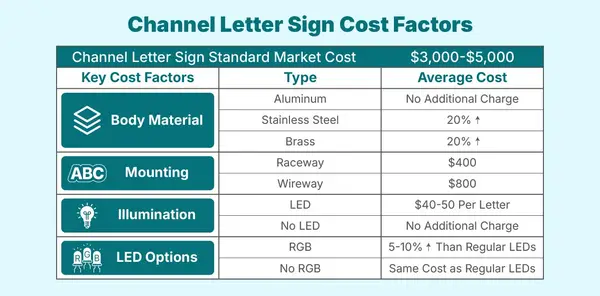
For outdoor signs, I spec either 304 or 316 stainless, never aluminum for returns. Aluminum is fine for small letters (up to 1.6mm thick) and weighs a third of steel, but it dents easily and the powder coat chips. For a strip mall in Ohio, 304 stainless (18% chromium, 8% nickel) gives 10+ years of outdoor life. For coastal areas like Miami Beach or any spot within 5 miles of salt water, you need 316 stainless with 2–3% molybdenum. It costs 20–30% more per letter, but I’ve watched a franchisee in Florida replace an entire 304 sign after three years because of pitting corrosion. That $300 extra cost per letter would have saved $4,000 in replacement. Do the math.
Acrylic quality is another cost trap. Mitsubishi or Degussa UV‑resistant acrylic lasts 5–8 years without yellowing. Domestic acrylic? 1–2 years before it looks like a cheap ice‑cream parlor. The difference on a 10‑letter sign is maybe $8 per letter. For a typical 5‑sign project, you’re spending an extra $400 to double the life of the face. That’s a no‑brainer.
It’s also worth noting that domestic fabricators can match these specs—if you push them. Many small shops use generic acrylic and painted steel to hit a low price. A fully spec’d domestic letter (304 stainless, Mitsubishi acrylic, Samsung LEDs) might come in at $350 instead of $120. You’re paying for local labor, faster turnaround, and no freight risk. That can be worth it for a one‑off sign or a rush job. But for a multi‑store roll‑out, the factory‑direct route still wins on cost and consistency—provided you vet the factory’s certifications (UL, CE, RoHS) and demand an 8‑hour burn‑in test before shipment.
Even the best‑made channel letters fail if installation is sloppy. Here are three rules I’ve learned the hard way:
One more tip: always keep a spare set of modules (10–20% of the total) and a spare driver for each sign. When a module fails after three years—and they will, because nothing is perfect—you can swap it in 15 minutes instead of scrambling for a custom‑color match.
The factory‑direct path isn’t for every project. Language barriers, longer lead times (4–6 weeks vs. 2 weeks domestic), and the risk of customs delays are real trade‑offs. I’ve had orders held up for a week at LAX because the “LED module” classification triggered an import review. If you’re on a tight grand‑opening schedule, domestic fabrication might be worth the premium. But for planned roll‑outs with a 30‑day lead time, the numbers are hard to beat—especially when you add the electricity savings and durability.
To keep your CFO comfortable, provide a simple one‑page summary: the landed cost per letter, the five‑year TCO comparison with neon, and a sample certificate of compliance from the factory (LM‑80 data for LEDs, material mill certificates for stainless). Then offer to split the first order: test five letters from the factory‑direct source, and five from a domestic shop. When the test letters arrive—identical in appearance, with the domestic ones costing two‑and‑a‑half times more—the debate is over. I’ve done it three times. It works every time.
At the end of the day, your job isn’t to pick sides between domestic and overseas. It’s to deliver a sign that lights up brighter, lasts longer, and costs less to own. Use the specs, the data, and a healthy dose of skepticism about every supplier’s claims. And if your CFO still pushes back? Show them this article—and the receipt for $47,400 saved.
Factory-direct since 2010. Free quote within 24 hours — no obligation.
Get a Free Quote →MOQ: 1 piece · 7-15 days · 2-year warranty · Worldwide shipping