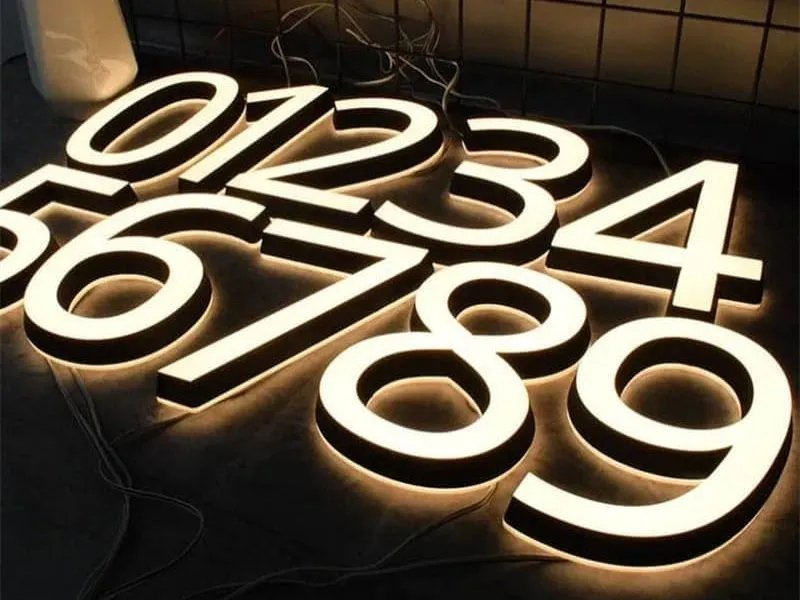
Here's what nobody tells you about the metal vs acrylic sign decision: it's not about metal being "better" or acrylic being "cheaper." It's about what your customer's building looks like at 3 PM and at 9 PM, in July and in January. I've been in this trade since 2010, and I've watched sign shops blow budgets on the wrong material more times than I can count.
Think about a strip mall in Arizona. Direct sun, 110 degrees. Acrylic face will go yellow in a couple years if you buy cheap domestic stock. But the landlord only gives you 3' of blade sign space, you're competing with a Subway and a Verizon store, and your client wants a glowing logo. Acrylic
channel letters are the right call. Just don't use the cheap acrylic.
The ugly truth is that most buyers don't think about material failure until the sign starts looking like garbage. Then they blame the fabricator. I'm not blaming you — I'm telling you what you need to know before you order 40 letters.
## What You're Actually Comparing
Metal signs — and I mean stainless steel, aluminum, and brass — are dimensional letters that sit on a wall. Acrylic signs are channel letters with acrylic faces, or light boxes that glow from within. The material choice changes everything downstream: fabrication cost, shipping weight, installation, and how many years that sign keeps its color.
Let's break it down.
## Stainless Steel: The 10-Year Champion
If you need an outdoor sign that still looks sharp after a decade, 304 stainless steel is your workhorse. We use it for our
stainless steel letters because it's got 18% chromium and 8% nickel, density of 7.93 g/cm³, and a real outdoor life of 10+ years. Common thicknesses are 1.0 to 3.0 mm — for letters over 2.5 meters tall, you go up to 5mm just like acrylic.
For the money, 304 is the honest sweet spot. It's not cheap, but it doesn't rot, doesn't yellow, and doesn't peel. Finishes: brushed #4, mirror #8, PVD, or powder coated. Brushed #4 is the classic storefront look. Mirror #8 is for luxury tenants who want to be fancy.
Here's what nobody tells you: the cheapest stainless steel sign will still cost you more than a fully-lit acrylic sign at the same size. Why? Fabrication. TIG welding, grinding, polishing — that's skill time, not material time. A 1-meter stainless letter can easily run you $40-80 per letter if it's non-lit. A front-lit acrylic channel letter might be $20-60.
But here's the thing — for a law firm, a bank, a real estate office, stainless steel changes the message. It says solid, permanent, trustworthy. Acrylic says bright, commercial, maybe a little flimsy. You're not just buying a sign. You're buying the way your customer's brand gets read.
I've seen this go wrong: a contractor ordered mirror-finish stainless steel letters for a coastal bakery. Six months later, salt air pitted the faces. He didn't know that coastal environments need 316 marine-grade stainless, not 304. 316 has 2-3% molybdenum and lasts 15+ years in marine conditions, but it costs 20-30% more. For a Miami Beach storefront, pay for 316. For a strip mall in Ohio, 304 is fine.
## Aluminum: The Lightweight Who Works
If you want the durability of metal without the weight or the price, aluminum is underused. It's 1/3 the weight of steel, naturally rust-proof, and has an 8-12 year outdoor life. We fabricate
aluminum letters from 1.0 to 1.6mm sheet — that's 0.040 to 0.063 inches. You get anodized, powder coated, brushed finishes, and you save on shipping.
Aluminum letters are the value king for non-lit storefront signage. Factory-direct pricing runs $10-25 per letter, not counting installation. That's half the price of stainless. But it's not going to hold a high-polish mirror finish for 10 years, and thin aluminum dents. Don't treat it like steel.
## Acrylic: The Glowing Workhorse
Now let's talk acrylic because that's probably what you're actually leaning on for 60% of your storefront jobs. Acrylic's optical property is a 90-92% light transmittance. That's why every
front-lit channel letter you see on a retail strip uses acrylic faces. It glows evenly and cheaply.
But acrylic has a dirty secret: UV resistance varies massively by sheet manufacturer. We use Mitsubishi or Degussa acrylic on anything that's going to see direct sun. That gives you 5-8 years before yellowing. Domestic Chinese acrylic? 1-2 years before it starts looking like a nicotine smoker's teeth. I know — you're paying $5 more per sheet. Do it.
For lighter colors — white, yellow, light green — cheap acrylic is a death sentence. The light just emphasizes the yellowing. If your customer runs a coffee shop with a white sign and sunny windows, don't touch a knockoff sheet. You'll be doing warranty repairs you didn't budget for.
## Halo Lit and Backlit: Where Acrylic Shines
The reason acrylic dominates the premium side of the market is back-lit halo channel letters. Light bounces off the wall behind the letter, not through the face. That means the acrylic face itself isn't the glowing part — the letter shape is. That's why
back-lit halo letters are the go-to for banks, hotels, and architecture firms. They look expensive because they are expensive — $35-120 per letter factory-direct.
But nobody talks about the spec that matters: you need enough LED spacing and the right module rating. A halo letter with cheap modules will have hot spots on the wall and dead zones within a year. Use quality modules from Samsung, Osram, or Blueview. They'll last 5+ years real. Cheap modules are 12-18 months, period.
## Light Boxes: The Menu Board Classic
If your storefront's main job is to say "breakfast, lunch, dinner" from half a mile away, you want an
acrylic light box. These run $80-250 per square meter factory-direct. They're the classic
food menu signs you see in front of diners and fast-food places.
The mistake I see: people order light boxes with LED strips spaced too far apart. Then you get the bright washing-machine effect — patches of light and dark on the face. Use SMD 2835 modules, 100-150 lumens per watt, spaced tight enough for the box depth. And don't cheap out on the power supply. A low-end supply will flicker. Your customer notices flicker. Then you get a phone call.
## Face to Face: Metal vs Acrylic on Price, Maintenance, Longevity
Let's put it in a list so you can show it to a buyer without crying.
- Cost (factory-direct): Aluminum letters $10-25/letter. Stainless non-lit $15-40/letter. Front-lit channel letters $20-80/letter. Halo lit $35-120/letter. Light boxes $80-250/sqm.
- Durability: 304 stainless 10+ years. Aluminum 8-12 years. Acrylic face 5-8 years with premium sheet, 1-2 with cheap. LED modules L70 ≥ 50,000 hours.
- Maintenance: Metal needs cleaning. Acrylic needs cleaning AND checking for UV damage. LED drivers fail eventually — budget for replacement.
- Shock factor: Metal at dusk, non-lit = classy but invisible. Acrylic front-lit = visible, commercial, bright. Halo lit = architectural statement.
## What Actually Drives Your Decision
Don't decide based on "which lasts longer." Decide based on what the sign has to do.
Ask three questions:
1. Is the sign going to be seen at night? Yes -> acrylic front-lit or halo. No -> stainless metal is fine.
2. Is the building modern and minimal? Yes -> rimless or slim aluminum letters. No -> traditional channel letters.
3. Is the client going to expect a glowing sign because the competitor has one? Yes -> don't argue. Give them a
dual-lit channel letter that works both day and night.
You'll be better off than 80% of the sign shops out there.
## The Rookie Mistake: Mixing Materials Without Thinking
I see a lot of storefronts where someone paired
stainless steel letters with an acrylic light box. It can work if the colors match. But usually the metal is cool gray and the acrylic box is warm white, and the whole facade looks like two different shops that got merged.
If you're going to mix materials, keep the color temperature consistent. Use the same white balance: 3000-3500K for hospitality, 4000-5000K for retail and office, 6000-6500K for industrial. That's the number that matters more than "metal vs acrylic." A warm sign next to a cool sign is a rookie giveaway.
## Factory Honesty: What We Can and Can't Do
Let me be blunt. Aochuang Sign is a 3,000-square-meter factory in Lu'an, Anhui, China with 50+ workers, exporting worldwide. We have CE, RoHS, ISO 9001. MOQ is one piece. Lead time is about 5-15 days. We give 2-year LED warranty and 1-year power supply warranty. That's what we can do.
What we can't do: we can't guarantee a UL certification on a single sign quickly. UL 48 costs $4,000-15,000 and takes 4-9 months with quarterly audits. If you need UL for a US project, plan ahead. ETL is 10-30% cheaper and a solid alternative. CE is common, we've got it, but it doesn't replace UL for US electrical inspection. Know your NEC Article 600 code requirements before importing.
Also: the US Section 301 tariff is about 30% on Chinese-made signs. We can't wave that away. We can give you the actual product cost you're paying at the border, but you've got to carry the tariff in your quote. Too many importers get burned because they didn't plan for duties.
## The Hidden Cost That Nobody Quotes
Shipping. I've seen sign shop owners compare our factory price against a US fabricator and then forget that a crate of steel letters weighs a ton. Literally. Stainless steel density is 7.93 g/cm³, so it's heavy. Sea freight runs $80-200 per cubic meter LCL or $1,200-3,000 per full container. Express is $30-100 for small packages, air is $4-12/kg. For a full storefront metal letter package, sea freight is almost always the answer, but that means about 65 days from our dock to your door. Order accordingly.
## The Answer to "Which Is Better?"
Better is a dirty word. Use "correct for the job."
For a single-story retail tenant in a shopping center with a flat strip-mall facade — the answer is a
front-lit channel letter with acrylic faces, quality LED, and an aluminum return. It's cheaper, brighter, and easier to install than stainless.
For a financial advisor on a corner lot with a glass curtain wall — the answer is stainless steel letters, possibly halo lit. It says stable, established, expensive. Price may be double, but the value perception goes through the roof.
For a restaurant with a menu to show and no interior lighting budget — the answer is an acrylic light box with high-CRI, 4000K neutral white LED modules.
The metal vs acrylic question is a false binary. You don't choose a material. You choose a customer, a location, a brand, and a budget. Then you pick the material that wins.
## One Last Piece of Advice
Visit your sign in the daylight and at night. Stand across the street. If it doesn't read in three seconds, it's a failure no matter what material you used. That's the skill nobody puts in a spec sheet.
You're welcome to ask me about a project you're working on. We're not faking the experience — we've built these signs since 2010 and we'll tell you straight whether your project needs metal, acrylic, or a hybrid. That's the real service.