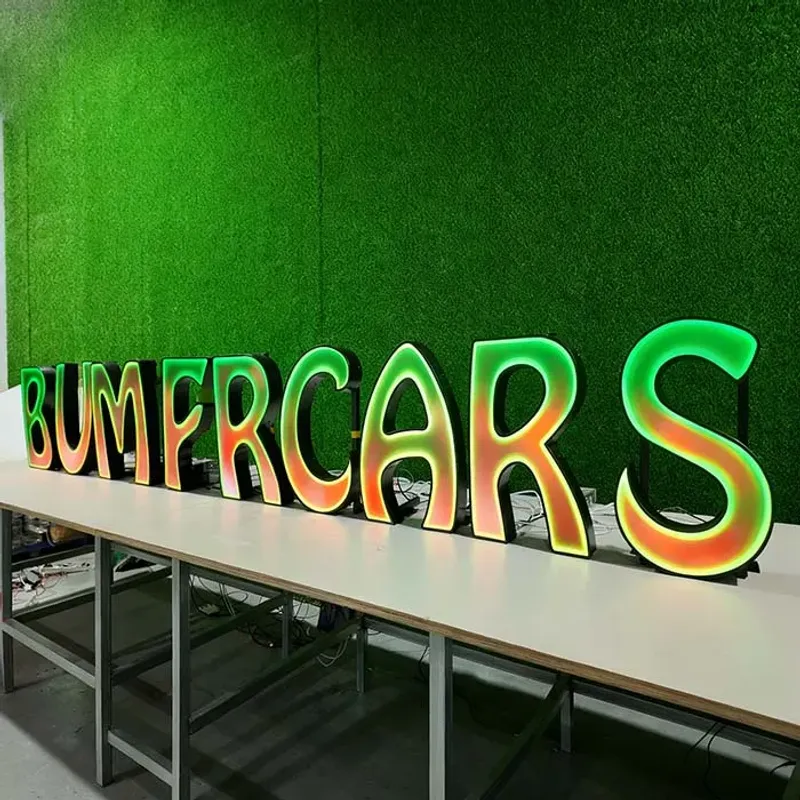
You want a hardware template? Don't ask for a pretty PDF. Ask for a hole pattern that matches the damn sign.
I've watched installers hold a paper template against a brick wall in a 20 mph wind, punch through it with a Sharpie, and then act surprised when six of ten holes don't line up. Templates aren't a suggestion. They're the difference between a sign that stays on the wall and one that ends up in the parking lot. And if you're sourcing signs overseas, the template is the only thing standing between you and a very expensive Tuesday morning re-drill.
Here's what nobody tells you: dead load matters more than wind load for most channel letter installs. A set of 304/316 stainless steel letters isn't light. 304 stainless runs 7.93 grams per cubic centimeter. Take a 3mm-thick face, 40mm returns, LED modules, acrylic face, power supply—do the math on a 10-foot sign. That's not a poster. The anchors aren't just holding up the sign; they're holding up the sign plus gravity day after day.
Wind load is the part that scares the permit reviewer. You don't need an engineering degree to know a 60 mph gust on a flat sign face is a different animal than a gentle breeze. But here's the ugly truth: most small shops guess. They take the square footage, multiply by some factor they half-remember from a code class, and hope the inspector doesn't ask for calcs. Then the raceway rips off a stucco wall because somebody used drywall anchors rated for 40 pounds on a 150-pound sign. Get a stamped drawing. Your mounting template means nothing if the hardware behind it isn't rated for the actual load.
Seismic? If you're in California, Oregon, or anywhere near a fault line, the same anchor that works for dead load might shear right out when the ground moves. Use all-thread through the wall with backing plates. Through-bolts. Epoxy anchors. Not plastic plugs. I don't care if the sign weighs 30 pounds.
Look, I'm not a structural engineer and I won't pretend to be one. But I've built enough signs to know what fails first.
The dead load is straightforward. Aluminum weighs one third of steel, which is why extruded aluminum cabinets are easier on a wall. That's a fact I use every week. Stainless steel letters weigh more, and if you spec 5mm-thick acrylic faces on a 2.5-meter sign, you're adding weight no one planned for. Over 2.5 meters, you should be using 5mm or thicker acrylic anyway. The 2mm stuff flexes like a noodle in the wind and then cracks at the mounting holes.
Wind load isn't static. A 4x8 sign face in a parking lot in Kansas sees different forces than a 3-foot-tall set of front-lit letters under an awning in Chicago. The local code wants ASCE 7-16 or whatever version they've adopted, with exposure category and gust factor. If you haven't got a stamped drawing, they'll bounce you. I've been on the phone with a fabricator in Texas who was trying to reuse a Miami wind load calc for a job in Lubbock. Don't do that. The wind speed maps are different. The building department will catch it.
Seismic load is the one that gets ignored. Here's what I tell my guys: if the building is designed to move, your sign has to move with it. That means flexible connections, not rigid bolts snapped tight. A raceway bolted with no slop can crack the wall when the building sways. You need a template that accounts for anchor spacing, not just hole centers. If the holes are too close to the edge of the raceway, the whole thing will tear like a perforated coupon.
Look, brackets are not all the same. A flimsy L-bracket from the hardware store is fine for a 2-pound house number, not for a 35-pound backlit letter set.
For back-lit halo letters, standoffs are the standard. You need that air gap off the wall for the halo to work. The template has to show the standoff center points, not just a circle. If you're off by 3mm, the letter either sits crooked or the standoff won't thread into the backer plate. I've seen this go wrong: a crew drilled 48 holes for a 12-letter halo set using a paper template. Half the holes were off by just enough that the installers spent four hours slotting holes with a die grinder. By hour three, they were cursing the template maker. A CAD file or a rigid acrylic template would've saved them the whole afternoon.
Raceways are the workhorse for front-lit channel letters. If you're ordering front-lit channel letters for a storefront, a raceway is the default. It hides the wiring, gives you a flat surface to mount to, and makes a future LED swap a hell of a lot easier. But a raceway is only as good as the anchors that hold it. On brick, use sleeve anchors or through-bolts. On concrete, wedge anchors. On stucco, you're not anchoring to stucco—you're anchoring to the framing behind it. Use toggles or hit the studs. Stucco is decorative, not structural. I don't care what the box says.
Aluminum angle brackets work for lighter signs, but they need isolation washers if they're bolted to steel. More on that in a minute. The point is: your hardware template has to match the hardware type. A raceway template doesn't work for standoffs. A standoff template doesn't work for through-bolts. Don't try to make one template do everything. That's how holes end up in the wrong place.
Here's what nobody tells you: stainless fasteners in aluminum can cause galvanic corrosion if you don't use isolation washers. I've watched aluminum sign cabinets rot around stainless bolts because nobody put a nylon washer between the two metals. It's a rookie mistake that shows up three years later as a chalky white powder around the bolt heads. By then the sign is loose and the wall is stained.
304 stainless steel is the default for most outdoor signs. It's got 18% chromium and 8% nickel, and it'll last 10+ years outside. But if you're within a few miles of salt water, don't even think about 304. Pay for 316. 316 contains 2-3% molybdenum, which is what makes it marine grade. It costs 20-30% more than 304. For a strip mall in Ohio, 304 is fine. For Miami Beach, pay for 316 or you're replacing letters in 3 years. I've had that conversation with a customer who tried to save $400 on a 20-letter sign. He spent $2,000 on replacement and installation two years later.
Aluminum is naturally rust-proof, but that doesn't mean it's bombproof. Powder coated aluminum will give you 8-12 years outdoors if the coating isn't scratched. Anodized aluminum holds up better against UV but shows water spots. If you're using aluminum brackets with stainless fasteners, use isolation washers. If you're mixing materials on the wall—say, aluminum raceway with stainless letters—keep an eye on the contact points. Corrosion is slow, but it never sleeps.
Acrylic faces don't corrode, but they do yellow. UV-resistant acrylic from Mitsubishi or Degussa will last 5-8 years before you see any yellowing. Domestic acrylic? 1-2 years and it looks like a smoker's teeth. That matters for the template because a yellowed face means a sign replacement, and if your original holes don't match the new letters, you're patching and repainting the entire wall. Drill once. Drill right.
I've seen this go wrong: a competitor sent a laminated paper template that had been photocopied twice. The scale was off by 1.5%. Nobody checked. The installer drilled 40 holes for a 10-letter sign. Not one of them lined up with the actual letter returns. He ended up drilling new holes and filling the old ones with silicone. It looked like a shotgun blast. The customer made him repaint the entire facade.
Our laser cutter holds ±0.1mm. That means the hole pattern on our template matches the holes in the returns. When you're aligning acrylic LED letters or halo letters, 0.1mm is more than enough. But only if you use a rigid template or a digital CAD file. Paper moves. It stretches, it rips, it gets wet. I don't care how careful your installer is. A paper template is a suggestion, not a tool.
For CNC work, you want a DXF or DWG file with true-to-scale dimensions. Not a low-res PDF that some office assistant printed from a screenshot. We send vector files with every order—DXF for the router, PDF for the field. The hole centers are marked with crosshairs, not circles. Crosshairs show you the exact center point. Circles just show you where the drill bit should go, and if the bit wanders, you're off. Here's what I tell installers: use a center punch, then drill a pilot hole, then drill the final size. Don't try to knock a 1/2-inch hole in one shot. You'll crack the brick or skate across the stucco.
For back-lit halo letters, the tolerance is tighter. The standoff threads into the backer plate, and if the hole is off by 1mm, the letter either won't sit flush or the standoff binds. Check the template against the actual fabricated letter before you drill. Not just the drawing. The actual letter. Fabrication tolerances have tolerances.
The ugly truth is: local inspectors will fail you for not having a listed sign in many jurisdictions. Don't argue. Just get the ETL or UL listing.
UL 48 is the big one for electric signs in the US. It costs $4,000 to $15,000 for the certification, takes 4-9 months, and comes with quarterly audits. ETL is a legitimate alternative and typically runs 10-30% cheaper. If a factory says they have UL, ask for the certificate with today's date. Many of them have an old cert that expired. CE marking? CE costs 20,000-50,000 RMB and takes 2-8 weeks. Almost every Chinese factory will say they have CE. Ask to see the certificate with today's date. Watch them sweat.
For outdoor signs, IP65 is the minimum. It means dust-tight and protected against water jets from any direction. It does NOT mean your sign survives a Florida hurricane. IP66 is for coastal areas with powerful water jets. IP68 is submersible—extreme weather or flooded installations. If someone tries to sell you an IP68 sign for a strip mall, they're either confused or padding the invoice.
ADA applies to tactile signs, not channel letters, but if you're doing wayfinding or interior directional signs, remember: tactile signs mount 48-60 inches from the floor, need non-glare finish, and require Grade 2 Braille. That's not a suggestion. That's federal law. Get the mounting template right or the inspector will make you move every sign.
NEC Article 600 covers electric signs in the US. That means no exposed high-voltage wiring, proper disconnects, and weatherproof connections. Your template should account for the wiring chase, not just the mounting holes. If the holes block the knockout for the power supply, you're drilling twice.
Here's what nobody tells you: most factories won't give you a real CAD template until you've paid. We send one with the artwork proof—free. Not a marketing line. It's how we avoid re-drills and angry phone calls.
Our process is a 10-step slog: design confirmation in 1 day, laser cutting at ±0.1mm in 1-2 days, TIG welding in 1-2 days, grinding and polishing in 1-2 days, CNC acrylic faces in 1 day, LED assembly in 1-2 days, sealing with neutral silicone in 1 day, 8-12 hours of aging test, 100% QC inspection, then export packaging with foam, carton, and plywood crate. Total lead time: about 5-15 days. MOQ is 1 piece. One piece. You want one front-lit letter with a matching template? We'll build it.
I've watched sign shops pay $800 for a front-lit letter from a domestic fabricator. Same 304 stainless, same Samsung LEDs. We ship that letter for $120. The savings aren't because we cut corners—we don't. It's because our labor costs are lower and we don't have a sales rep with a company car to pay for. We include the template because it costs us almost nothing and it saves us from that 2 a.m. email with a photo of a crooked sign.
If you're ordering front-lit channel letters from any factory, ask for the DXF file before you pay. If they say they'll send it after production, walk away. That means they don't have the hole pattern finalized, which means they're making it up as they go. A real factory has the CAD file ready before the first weld. We do. The template isn't an afterthought. It's the first thing the installer sees.
A mounting template isn't just for installation. It's for the day you have to replace a module or a whole letter. If you don't have the hole pattern on file, you're either guessing or paying for a site survey.
LED modules have an L70 rating of 50,000 hours—that's the point where light output drops to 70% of original. Quality modules from Samsung, Osram, or Blueview will run 5+ years real lifespan. Cheap modules? 12-18 months before you start seeing dim spots. The warranty on our LEDs is 2 years, power supply 1 year. That's not a guarantee against abuse; it's a guarantee against manufacturing defects. If a module fails, you need to know which letter to open and where the mounting screws are. The template tells you that.
Water is the enemy. Our signs are sealed with neutral silicone, but silicone doesn't last forever. Check the sealant beads every 12 months. If you see cracks or gaps, reseal. The aging test we run—8-12 hours powered on—catches most early failures, but it won't catch a screw that loosens over three winters. Retorque the mounting hardware annually. Use a torque wrench. Don't just crank it until your elbow clicks.
If you're on the coast, rinse the salt off the sign face and hardware every few months. Salt eats stainless steel, even 316 if it sits long enough. And if you see rust bleeding from a 304 sign in a coastal environment, that's not a defect. That's the wrong material choice. Replace with 316. Your template holes might still work if the letter size didn't change. Often it doesn't. That's why you keep the file.
Sea freight LCL crates get handled 6-8 times between our dock and yours. Every touch is a chance for damage. That's not in the brochure. When the crate arrives, check the template against the actual letters before the installer gets on the ladder. If a fork truck speared the crate and bent a letter, you want to know before you drill 20 holes. Not after.
"Can you just email me a template for a sign I haven't ordered yet?" No. Templates match specific letters. Different returns, different standoffs, different tolerances. If I send you a generic template, you'll drill wrong holes and blame me. Send me the drawing. Then we'll talk.
"Why can't I just use the paper template in the box?" Because paper moves. It stretches, it rips, it gets wet, and it lies. If you're drilling a $2,000 sign into a brick wall, use a rigid template or a CAD file. If you use paper and it's wrong, that's on you, not the factory.
"Do I really need stainless hardware for an outdoor sign in Arizona?" Arizona is dry, no salt, UV is the enemy. Stainless is fine but maybe overkill. Aluminum will work. But if you're anywhere near the ocean, use 316 stainless. 304 will pit. I've seen it happen in 3 years. Don't be the guy who saves $50 on fasteners and spends $500 on a replacement sign.
"Can I install a 100-pound sign with toggle bolts into drywall?" You're joking, right? No. Absolutely not. A 100-pound sign needs structural anchors into framing or solid substrate. Toggle bolts into drywall are for coat hooks, not signs. If you have to ask, hire a licensed installer.

Real photo from our production floor — every sign we ship is made here.
Products mentioned or relevant to this topic — factory-direct, custom built.
From $24/letter · MOQ 1 piece · Flexible lead time · CE & UL certified · ships to 20+ countries
Custom sizes, colors, and finishes. Get a factory price in 24 hours.
Get a Free Quote Copy EmailWhatsApp +86 13865703472 · business@aochuangsign.cn