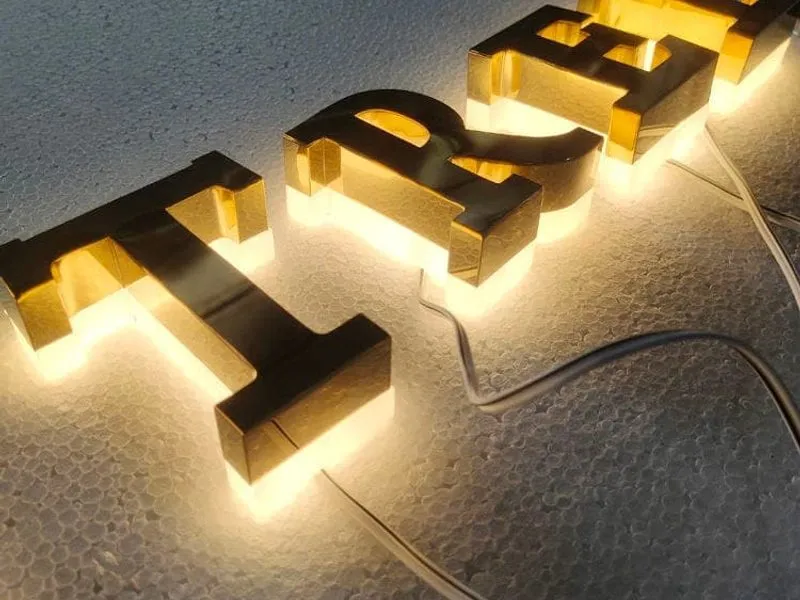
I've watched sign shops pay $800 for a front-lit letter from a domestic fabricator. Same 304 stainless, same Samsung LEDs. We ship that letter for $120.
That's not a typo.
Before you spend another dime on stainless steel letters, you need to know what actually drives cost, what holds up, and what's going to fall off the wall in two years. I've been building signs since 2010, on the floor, not in a spreadsheet.
I've burned my hands on hot acrylic and argued with suppliers about LED quality. Here's what I'd tell you over a beer after work.
Flat cut. Fabricated channel. Reverse/halo-lit. Cast. That's the menu, and they don't all play nice with every project.
Flat cut 304/316 stainless steel letters are exactly what they sound like: a sheet of 1.0-3.0mm stainless cut to shape with a laser or waterjet. We laser cut them to ±0.1mm. They're cheap, quick, and they don't light up unless you stick an LED behind them.
We build fabricated channel letters with separate face, returns, and back. TIG welded, ground, polished. They can be front-lit, backlit, or both. You spend money on labor here—and a factory like ours earns its keep. If you're ordering front-lit channel letters for a storefront, expect about 5-15 days production.
Reverse/halo-lit letters are the architectural crowd favorite. The face stays solid stainless, and the LED sits behind, throwing a soft halo onto the wall. I've sold a ton of back-lit halo letters to law firms and medical offices. They look premium, but they cost more because you're buying both the metal and a quality LED array.
Cast stainless is the heavyweight.
I once had a customer insist on cast for a 4-inch interior door sign. Took three guys to hang it. The drywall anchor gave up before the letter did.
Here's what nobody tells you: 316 stainless costs 20-30% more than 304. For a strip mall in Ohio, 304 is fine. For Miami Beach, pay for 316 or you're replacing letters in 3 years.
304 has 18% chromium and 8% nickel. Baseline.
It'll survive 10+ years outdoors in normal conditions. Density is 7.93g/cm³, so it's heavy no matter which grade you pick.
316 adds 2-3% molybdenum. That's the magic for marine and industrial air. Salt eats 304 eventually; 316 holds up 15+ years.
I've replaced 304 letters on a Miami restaurant after 3 years. The 316 ones next door were fine. That's not a marketing line; that's what salt does.
Don't let anyone sell you "stainless" without the mill cert. If the chromium and nickel numbers aren't on paper, it's probably not what they say it is.
And for the love of everything, don't spec 316 for an interior office just because it sounds tougher. You're burning money.
Brushed #4 is your workhorse. It hides fingerprints and minor scratches. If you don't know what to pick, pick brushed.
Mirror #8 is the show-off. I'm talking that mirror polished face you can check your teeth in. It's gorgeous indoors, but outdoors it's a maintenance headache unless you're in a clean environment. Water spots show up in a week.
PVD is the new hotness for color. Gold, black, bronze—vapor deposition bonds the color to the metal so it doesn't peel like paint. Powder coating is still fine for RAL colors, but it won't have that metallic depth.
If you're near salt air, don't put mirror #8 outside. It'll pit and haze within a year, and your client will blame you, not the finish.
If you're unsure, order a physical sample. Photos lie.
I've seen this go wrong: a sign shop mounted 36-inch stainless letters with drywall anchors because the client didn't want to pay for a raceway. Six months later, a 22-pound letter peeled off and shattered a tile floor. Nobody got hurt, but that's pure luck.
Stainless is dense—7.93g/cm³. A 2mm thick fabricated letter isn't a toy. You need studs into structure or a properly engineered raceway. Not toggle bolts in drywall.
Direct mount with standoffs is clean if you have a solid substrate. You attach studs to the back of the letter, then drill into masonry or backing. Use neutral silicone to seal penetrations—that's in our 10-step process for a reason.
Raceways add cost, but they also hide wiring and distribute weight. If the wall is brick, raceway might save you a world of pain.
For backlit/halo letters, pay attention to standoff depth.
IP65 sounds impressive. That rating means water jets from any direction. It does NOT mean your sign survives a Florida hurricane.
For most stainless letters, you're choosing between SMD 2835 modules at 100-150 lm/W and SMD 5730 at 40-60 lm per chip for the brightest punch.
Quality modules from Samsung, Osram, or Blueview last 5+ years real-world. Cheap modules? 12-18 months before you're on a ladder swapping them out.
Color temperature matters more than most clients think. 3000-3500K warm for hospitality, 4000-5000K neutral for corporate and retail, 6000-6500K cool for industrial and highway. Pick the wrong one and a nice brushed steel sign looks like a gas station sign.
Power supplies carry a 1-year warranty, LEDs a 2-year. That's standard. If a supplier offers 5 years on cheap modules, they're lying to you.
Quickest way to spot bad LED modules: look at the solder joints. Dull gray = won't last 18 months; shiny silver = proper lead-free solder.
Look, if you're paying $800 per front-lit steel letter installed, you're not buying a better sign. You're buying someone's showroom overhead.
Factory prices per letter run like this: non-lit stainless $15-40, front-lit channel $20-80, back-lit halo $35-120, 3D fabricated $40-120. US retail installed numbers? $200-700 for front-lit, $400-1,000 for halo. That's a 50-65% savings factory direct.
What drives the price? Material thickness (1.0mm vs 3.0mm changes everything), finish (mirror #8 and PVD cost more than brushed #4), mounting pattern (studs vs raceway), and LED quality. Size matters, but not as much as you'd think for channel letters—labor is labor at 18 inches or 24 inches.
The 3mm acrylic face cuts 92% light output; a 2mm face cuts 90%. Your customer won't notice the 2%, but they'll notice the 40% cost bump. Don't over-spec 3mm stainless on an interior door sign.
I've watched buyers pick 2mm 304 with brushed finish and Samsung LEDs, then faint when I tell them $28 per letter. Meanwhile their local quote was $450 installed.
Do the math. Buy smart.
Here's what nobody tells you: LCL sea freight gets handled 6-8 times between our dock and yours. Every touch is a chance for damage. That's not in the brochure.
But factory direct still wins if you do it right. We run a 10-step process: design confirmation, laser cutting at ±0.1mm, TIG welding, grinding/polishing, acrylic face CNC, LED assembly, sealing with neutral silicone, 8-12 hour aging test, 100% QC inspection, then export packaging with foam, carton, and plywood crate.
Every letter leaves our 3,000m² facility in Lu'an, Anhui with a 2-year LED warranty and a 1-year power supply warranty. ISO 9001, CE, RoHS—ask to see the certificates with today's date. CE marking costs 20,000-50,000 RMB and takes 2-8 weeks. Most factories will say they have it. Ask for the certificate. Watch them sweat.
If you need UL for US electrical compliance, that's a different game: $4,000-15,000, 4-9 months, quarterly audits. ETL is a cheaper alternative, 10-30% less. Don't let a supplier tell you their cheap modules are "UL equivalent." They're not.
And yes, US Section 301 tariff adds about 30% on top of product cost. Even after that, factory direct still beats domestic by a wide margin.
MOQ is 1 piece. Lead time is about 5-15 days. Express shipping runs $30-100 for small orders, air $4-12/kg, sea $80-200/m³ LCL or $1,200-3,000 FCL. That's the whole menu.
Q: What's the difference between 304 and 316 stainless for letters?
Oh for— 304 is fine unless you're within spitting distance of salt water. 316 adds 2-3% molybdenum and costs 20-30% more. That's it.
Q: Can I mount stainless letters on drywall?
No. Next question. Use studs into structure or a raceway. Density is 7.93g/cm³; it's not a picture frame.
Q: What's a realistic budget for a 24-inch front-lit stainless letter?
Factory price $20-80 per letter. Installed by a US shop, $200-700 per letter. The gap is labor, overhead, and markup—not materials.
Q: How long will the LEDs last?
Quality modules: 5+ years real-world, L70 ≥50,000 hours. Cheap modules: 12-18 months. Your choice.

Real photo from our production floor — every sign we ship is made here.
Products mentioned or relevant to this topic — factory-direct, custom built.
From $24/letter · MOQ 1 piece · Flexible lead time · CE & UL certified · ships to 20+ countries
Custom sizes, colors, and finishes. Get a factory price in 24 hours.
Get a Free Quote Copy EmailWhatsApp +86 13865703472 · business@aochuangsign.cn