I've been building metal letters since before LED modules were cheap enough to put in every strip mall sign.
That's 16 years of watching buyers overpay for the wrong metal because a competitor scared them into thinking "stainless is always better." It isn't. Aluminum isn't the cheap weakling some shops claim. The right choice depends on where the sign lives, who's going to hit it, and what you're willing to pay per letter. We'll get into all of it.
This guide is for sign shop owners, contractors, importers, and business buyers who are done with sales fluff and ready to order the correct metal the first time.
Look, I've watched sign shops pay $40 a letter for "marine grade" 316 stainless when the job was a dental office in Kansas. That's not durability. That's a commission check for the sales rep.
Here's what nobody tells you: most outdoor signage doesn't fail because the metal corrodes. It fails because someone cheaped out on thickness, used the wrong alloy, or skipped the finish. A 1.0mm aluminum letter with proper powder coat will outlast a 1.0mm "stainless" letter that's actually 201 grade with a mirror polish. Alloy and coating matter more than the metal name.
Stainless steel 304 is the workhorse. It's got 18% chromium and 8% nickel, which is why it doesn't rust in normal outdoor conditions for 10+ years.
Stainless 316 adds 2-3% molybdenum. That's what makes it marine grade and gives you 15+ years near saltwater or industrial chemicals. It costs 20-30% more than 304.
Aluminum is a different animal. It weighs one-third of steel and naturally forms an oxide layer, so it won't rust red. Outdoor life runs 8-12 years if anodized or powder coated.
Those are the numbers I use on the factory floor. Anything else you hear is someone trying to sell you a story.
The ugly truth is both metals corrode under the wrong conditions. Stainless 304 will pit and rust if you install it within a few blocks of the ocean without passivation or a good coating. Aluminum will turn into white powder if exposed to constant salt spray without anodizing or powder coat.
For inland signage — strip malls, office parks, hospitals — 304 stainless and 1.5mm aluminum will both last a decade. The difference is weight and impact resistance.
Stainless laughs at shopping carts, hail, and drunk guys throwing rocks. Aluminum dents. That's why I tell customers: if the sign is within arm's reach of the public, go stainless 304 at 2.0mm minimum. If it's 20 feet up on a facade, aluminum saves money and install headaches.
Wind load is another factor. Stainless at 3.0mm can span larger open areas without bracing, but it's heavy. Aluminum at 1.6mm may need more mounting points for the same size. Lighter doesn't always mean easier — it means more fasteners sometimes.
Let's talk money. Our factory pricing for non-lit metal letters runs $15-40 per letter for stainless steel and $10-25 per letter for aluminum. Those are Aochuang prices, not retail installed prices. US sign shops charge $200-700 per letter installed for front-lit, but for non-lit metal letters the markup is still obscene.
Here's a real example. A 24-inch tall stainless steel logo with mirrored finish and 2.0mm thickness costs about $28 per letter from our factory. The same size in brushed aluminum at 1.5mm costs $14. Multiply that by 20 letters and you're looking at $560 for stainless versus $280 for aluminum. Both will last over 8 years inland.
That's the cost comparison nobody shows you because it kills the upsell on stainless. Check our stainless steel letters and aluminum letters pages for exact specs and current pricing.
316 stainless raises the per-letter cost 20-30%. For a coastal restaurant in Miami, it's worth every penny. For a dentist in Ohio, it's a waste.
Also factor thickness. Bumping aluminum from 1.0mm to 1.6mm adds maybe $3-5 per letter. Thicker stainless from 1.0mm to 2.0mm adds more because the material cost is higher. Don't order 3.0mm stainless for a 12-inch letter — that's overkill unless it's going on a highway pylon in hurricane territory.
Raw aluminum is cheap but ugly. If you don't anodize or powder coat it, expect oxidation and chalky residue within two years. That's not a durability failure — that's a finish failure from skipping a step.
Stainless can be left raw if you like the look, but mirror #8 shows fingerprints and water spots. Brushed #4 hides scratches better. PVD coating gives color but costs more than powder coat. Powder coating stainless is possible but less common because it hides the metal itself.
Maintenance is another factor. Both metals need cleaning. Stainless with a brushed finish hides dirt better than mirror. Aluminum with a dark powder coat shows water streaks. No metal is zero-maintenance, no matter what the brochure says.
I've seen this go wrong: a contractor ordered 500 "stainless steel" letters from a trading company. They arrived as 201 stainless — magnetic, rusts in months. He found out when a magnet stuck to the letters on site. Real 304 is non-magnetic or weakly magnetic after cold working. Always test a sample with a magnet and ask for a mill certificate.
Here's a lie I hear every week: "Aluminum is rust-proof so we don't need a coating." Bull. Aluminum doesn't rust like iron, but it corrodes. In coastal or industrial air, uncoated aluminum pits and develops white corrosion. The oxide layer helps a little, but it's not magic. Spend the $2 a letter on powder coat or anodizing.
Another rookie move: ordering 316 stainless but using standard 304 screws and brackets. The letter lasts 15 years; the fasteners rot in three and the sign falls off. Match your hardware to your metal. Stainless letters need stainless mounting studs, not zinc-plated screws.

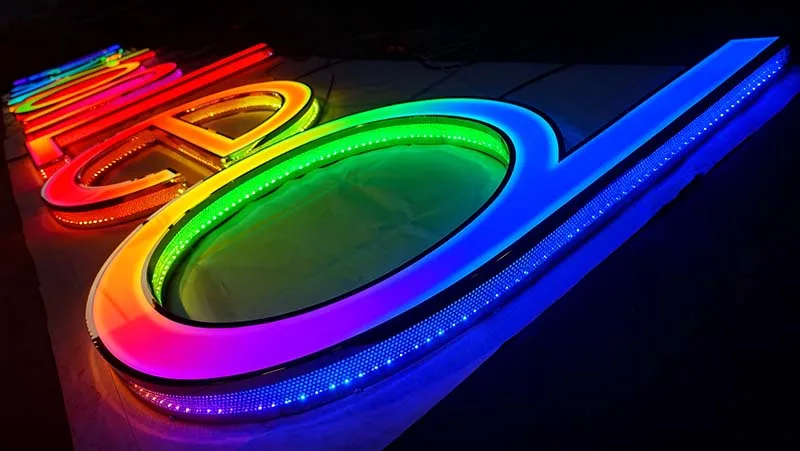
Real photo from our production floor — every sign we ship is made here.
Products mentioned or relevant to this topic — factory-direct, custom built.
Factory-direct since 2010. Free quote within 24 hours — no obligation.
Get a Free Quote → Copy EmailMOQ: 1 piece · Flexible lead time · 2-year warranty · Worldwide shipping
See pricing, specs, and get a free quote for the sign type you need. Built in our factory, shipped worldwide.