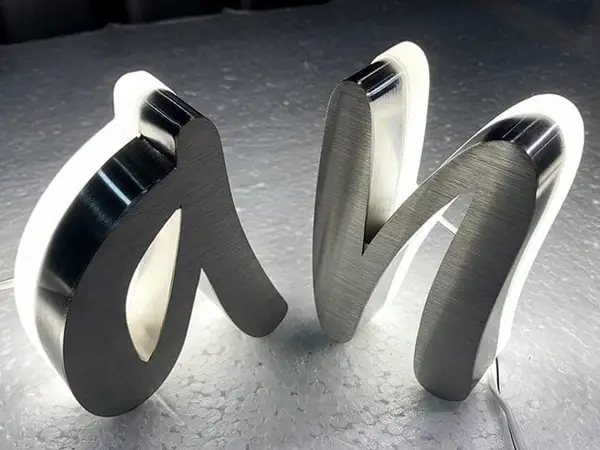
You're Not Buying a Sign. You're Buying a Decision.
I've been in procurement for 12 years. I've sourced signage from Chinese factories, local fabricators, and everyone in between. Here's what I've learned: the CFO doesn't care about letter fonts or LED color temperature. They care about depreciation, warranty claims, and whether that sign will still look good in five years without eating into the maintenance budget. So when you're choosing material for an outdoor sign, you're not picking a finish. You're making a bet on total cost of ownership.
Here's the brutal truth most blogs won't tell you: the material you pick determines 80% of your future headaches. Cheap acrylic yellows in two years. Domestic 304 stainless corrodes near the coast. And if you spec IP65 for a sign in Miami, you're practically asking for water damage. I've seen it all. Let's walk through the numbers so you can hand this to your boss with a straight face.
Acrylic: The Budget Trap That Looks Good at First
When I crunched the numbers for a national retail chain last year, acrylic seemed like the obvious choice. It's light, easy to fabricate, and gives that clean backlit glow. But the devil is in the UV-resistance ratings. Mitsubishi or Degussa acrylic — the good stuff — lasts 5-8 years before yellowing. Domestic acrylic? 1-2 years. That's not a typo.
The cost difference is real. Factory-direct, a 3mm UV-resistant acrylic sheet runs about $8-12 per square meter. Domestic acrylic is half that. But here's where the ROI works out: if you install a sign with cheap acrylic, you're replacing the face in 2026. Labor, truck roll, and new material will cost you $400-600 per letter for a front-lit
channel letter. Multiply that by 10 letters, and you've blown your entire sign budget.
Line by line, here's where the money goes for a 24" front-lit channel letter using quality acrylic:
- Factory price (China direct): $35-50 per letter
- Shipping (LCL sea + local drayage): $15-20
- US Section 301 tariff (~30%): $10-15
- Installation (union or non?): $100-200 per letter
- Total landed cost: $160-285 per letter
Compare that to domestic retail pricing of $200-700 per letter. You're saving 40-60%. But only if the material holds up. That's why I always spec Mitsubishi or Degussa acrylic. Ask your factory for the material supplier certificate. If they can't produce one, walk away.
Stainless Steel: 304 vs. 316 – The Coastal Cliff
Stainless steel is the workhorse of outdoor signage. It's strong, it lasts, and it looks professional. But not all stainless is equal. 304 contains 18% chromium and 8% nickel. Outdoors, it's good for 10+ years in most climates. 316 adds 2-3% molybdenum, pushing that to 15+ years, even in marine environments. The cost premium for 316 is 20-30%.
Here's the opinion from someone who's done the work: for a strip mall in Ohio, 304 is fine. For Miami Beach, pay for 316 or you're replacing letters in 3 years. I've watched sign shops pay $800 for a front-lit 304 letter from a domestic fabricator. Same 304 stainless, same Samsung LEDs. We ship that letter for $120 from our factory in Anhui. The markup is criminal.
But you have to factor in the tariff. US Section 301 adds about 30% on steel products from China. That $120 letter becomes $156 landed. Still a fraction of domestic. And with our ISO 9001-certified facility and 50+ skilled workers, the quality is consistent. We use TIG welding, ±0.1mm laser cutting, and a full aging test before packaging.
One rookie mistake I see all the time: specifying powder-coated stainless steel without understanding the finish. Brushed #4 is standard. Mirror #8 is a fingerprint magnet. For outdoor signs exposed to road salt or sea spray, go with PVD coating — it holds up better than powder coat over stainless.
Aluminum: Light, Lazy, and Often Overlooked
Aluminum weighs one-third of steel. It's naturally rust-proof. For a large-format sign that needs to hang on a storefront without reinforcing the wall, aluminum is your friend. 1.0-1.6mm thickness is standard. Outdoor life: 8-12 years with proper anodizing.
Here's what your boss will ask: "Why not just use aluminum for everything?" Because aluminum is soft. Drop a sign and you'll dent it. And for channel letters with deep returns, aluminum flexes more than stainless. You want sharp edges and crisp corners? Go stainless.
I recently sourced a series of 3D fabricated letters for a hotel chain. They wanted the look of brushed steel but needed to keep weight down. Solution: aluminum base with a stainless steel face laminate. Cost per letter: $50-75 factory direct, versus $100-150 for pure stainless. Shipping was cheaper too — lighter less volumetric weight.
But watch out for the finishing. Cheap anodizing can chip. Good anodizing is 0.4-0.8 mil thick, and you need the factory to show you their salt spray test data. We require 500-hour salt spray test for outdoor aluminum. If a factory can't provide that, they're cutting corners.
LED Modules: The Hidden Rottable That Eats Your Budget
You might think LEDs are LEDs. They're not. A quality SMD 2835 module using Samsung or Osram chips delivers 100-150 lumens per watt, with L70 life of 50,000+ hours. That's 5+ years real lifespan. Cheap modules use unbranded chips and fail in 12-18 months. The solder joints tell the story: dull gray = poor lead-free solder; shiny silver = proper process.
Quickest way to spot bad LED modules: look at the solder joints. Dull gray means you'll be swapping them out in 18 months. Each truck roll to replace a module costs $150-300. Multiply by 10 signs across 50 locations — that's $75,000 in maintenance you didn't budget for.
For outdoor signs, IP65 is the minimum. It means dust-tight and protected from water jets. But IP65 does NOT mean your sign survives a Florida hurricane. For coastal areas or regions with heavy rain, spec IP66 or even IP68 if the sign is ground-mounted and prone to flooding.
Color temperature matters too. 4000-5000K neutral white for corporate. 3000-3500K warm for hospitality. Don't let the marketing team pick 6000K cool white for a retail store — it makes everything look like a hospital.
Certifications: The Hidden Cost That Separates Professionals from Pretenders
Here's what your boss will ask: "Does the sign have UL certification?" The answer is complicated. UL 48 for electric signs costs $4,000-15,000 and takes 4-9 months. Most Chinese factories don't have it. They have CE marking, which costs 20,000-50,000 RMB (about $3,000-7,000) and takes 2-8 weeks. But CE is not the same as UL.
CE marking costs 20,000-50,000 RMB. Most factories will say they have it. Ask to see the certificate with today's date. Watch them sweat. I've learned that a valid CE certificate for an electrical sign must list the specific product model and standards (EN 60598, etc.). If it's vague, it's fake.
For the US market, you have two realistic options: ETL or UL. ETL is 10-30% cheaper and accepted by most building inspectors. You can get an ETL listing through an NRTL like Intertek. The factory has to submit samples and undergo quarterly audits. It's a pain, but without it, your insurance may not cover an electrical fire.
One story from my experience: a client ordered 500 signs from a factory that claimed to have UL. When the inspector showed up, the factory had nothing. We had to air-freight replacement modules to meet the deadline. That cost $12,000 in shipping alone. Lesson: verify certifications before production, not after.
Shipping and Damages: The Silent Budget Killer
LCL sea freight: your crate gets handled 6-8 times between our dock and yours. Every touch is a chance for damage. That's not in the brochure. I've seen crates dropped, forklifts piercing sides, and signs arriving with bent returns. Budget 5-10% for damage loss, especially with acrylic.
For large quantities, consider FCL (full container load). 20-foot container holds about 200-300 letters, depending on size. Cost: $1,200-3,000 from China to US West Coast. Split that over the order, and your per-unit shipping drops dramatically. For smaller orders, air freight at $4-12/kg gets your sign in about 10 days. But you pay for speed.
The packaging matters more than you think. We use 5-ply cartons inside plywood crates, with foam inserts and corner protectors. It adds about 5% to the material cost but cuts damage claims by 60%. I've seen competitors use single-wall cartons and poly bags. Their customers get broken signs. Your ROI depends on it arriving intact.
Three Frequently Annoying Questions (And the Answers You Need)
Q: Why can't I just buy domestically? It's easier and supports local jobs.
I've answered this a hundred times. Domestic fabrication is great for one-off signs or rush jobs. For a chain of 50 locations, you're paying 50-65% more for the same product. That $1,200 a sign adds up to $60,000. If your CFO doesn't care about that, fine. But you're leaving money on the table that could go to marketing or operations. I'm not saying go overseas blindly — but do the math with landed cost, including tariff and shipping. Usually, you come out ahead by 30-40%.
Q: What about warranty? If the sign fails in two years, I'm stuck.
We offer 2 years on LEDs, 1 year on power supply. That's standard for the industry. But warranty means nothing if the factory disappears. That's why I only work with factories that have been around since 2010, have ISO 9001, and can provide bank references. A 2-year warranty from a Chinese factory with no track record is worthless. Conversely, a 5-year warranty from a domestic manufacturer often has hidden exclusions. Read the fine print.
Q: Can I get IP68 on a channel letter? That sounds safer.
IP68 means submersible beyond 1 meter. You don't need it for a wall-mounted sign unless it's in a flood zone. IP66 is powerful jets and is sufficient for most outdoor installations. Over-specifying IP68 adds cost and complexity — thicker gaskets, more sealant, potential heat buildup. Stick with IP66 for coastal, IP65 for inland. And make sure the factory uses neutral silicone sealant, not acid-cure, which corrodes aluminum.
Q: How do I know if the acrylic is really UV-resistant?
Ask for the manufacturer's certificate. Mitsubishi and Degussa provide batch numbers. If the factory can't tell you which brand they use, assume it's domestic. Another test: hold a sample under a UV lamp for 48 hours. If it yellows, reject the entire lot. But honestly, if you're ordering from a reputable factory like Aochuang, we use Mitsubishi as standard unless otherwise specified. Don't let price push you into cheap acrylic — the replacement cost will kill your project.