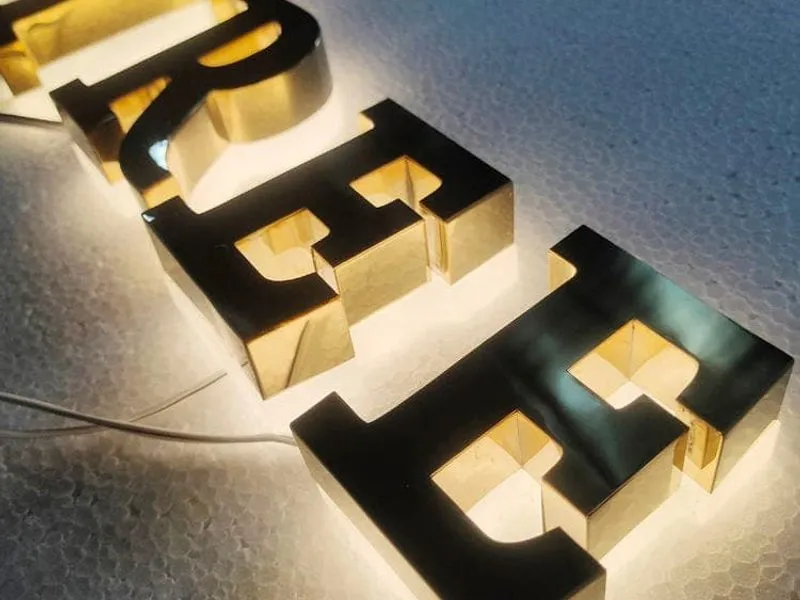
You’re looking at a front-lit channel letter quote for $800 a pop from a domestic shop. I’ve seen that same letter—same 304 stainless, same Samsung LEDs—come off our line for $120. And I don’t mean a knockoff. I mean the exact spec you’d sign off on.
Here's what nobody tells you: the guy quoting $800 is probably buying from the same factory I work at, then doubling the price with a markup for "project management" and "quality assurance." The ugly truth is most of that middleman value is smoke. I've spent 16 years on this floor, burned my hands on hot acrylic more times than I remember, and argued with suppliers about LED binning when they tried to slip cheap 2835s into a premium order. This article is the stuff your sales rep won't say.
I've watched sign shops pay $800 for a front-lit letter from a domestic fabricator. Same 304 stainless, same Samsung LEDs. We ship that letter for $120.
I'll say it plain: the acrylic you choose determines whether your sign looks good for eight years or looks like a yellowed tooth after two. Mitsubishi and Degussa acrylic gives 90-92% light transmittance and UV resistance for five to eight years. Domestic acrylic? One to two years before it starts yellowing. That’s not opinion—that’s what happens when you cheap out on the polymer.
For outdoor signs over 2.5 meters, never use less than 5mm thickness. I've seen a 3mm face crack in a wind gust because the installer didn't account for deflection. The factory's laser cutter hits ±0.1mm tolerance, but if you spec thin acrylic, nothing else matters. Same story with stainless steel. 304 is fine for Ohio strip malls—10+ year outdoor life with 18% chromium and 8% nickel. But if your job is on the coast, you need 316 with 2-3% molybdenum or you're replacing letters in three years. The 20-30% premium is cheap insurance against rust pitting.
The quickest way to spot bad LED modules: look at the solder joints. Dull gray = won't last 18 months. Shiny silver = proper lead-free solder. I've seen cheap modules fail in twelve months flat because the factory used acid flux to save twenty cents per board.
Here's what nobody tells you: the upfront price is the smallest part of what you'll spend. Factory prices for front-lit channel letters run $20-80 per letter. Back-lit halo letters $35-120. Stainless steel non-lit $15-40. Those are direct from our floor. But then you add shipping, tariffs, and installation. Sea freight for a full container (FCL) runs $1,200-3,000. LCL—less than container load—your crate gets handled six to eight times between our dock and yours. Every touch is a chance for a dent. That's not in the brochure.
I've watched sign shops pay $800 for a front-lit letter from a domestic fabricator. Same 304 stainless, same Samsung LEDs. We ship that letter for $120.
Then there's the US Section 301 tariff on Chinese goods—roughly 30%. You have to factor that into your total cost. But even after tariff, the factory-direct savings are 50-65% off product cost. The real killer is maintenance. Cheap LED modules with L70 less than 30,000 hours will need replacement in two years. Our Samsung/Osram modules have L70 ≥50,000 hours—real lifespan five years plus. That's the difference between buying once and buying twice.
IP65 sounds impressive. It means dust-tight and water jets from any direction. It does NOT mean your sign survives a Florida hurricane. For that you need IP66 or IP68, which are actually tested for powerful jets and submersion. I can't count how many "waterproof" signs came back because the factory used neutral silicone that wasn't rated for UV. We test every seal with a 24-hour water drip before it ships. Most places don't.
The ugly truth is CE marking costs 20,000-50,000 RMB to certify. Most small factories will say they have it. Ask to see the certificate with today's date. Watch them sweat. We've got CE, RoHS, ISO 9001—but I still advise clients to request UL or ETL if the job requires it. UL 48 certification runs $4,000-15,000 and takes four to nine months with quarterly audits. ETL is 10-30% cheaper and accepted in most jurisdictions. If your local inspector demands UL, don't let the factory tell you CE is equivalent. It's not.
NEC Article 600 applies to all electrical signage in the US. ADA compliance for tactile signs means mounting at 48-60 inches, non-glare finish, Grade 2 Braille. If you skip this, your hotel chain client can sue you. I've seen it happen.
Most articles say "ask for a discount." That's amateur hour. Here's the real play: commit to a monthly volume. We have a 3,000m² facility and 50 workers. If you promise us six container loads a year, we'll give you pricing that makes your competitors cry. Our MOQ is one piece—that's true—but one piece doesn't get you a seat at the negotiation table.
For volume orders: ask for free tooling, ask for priority production slots (about 5-15 days standard, but we can do 5 on rush for repeat clients), and ask for extended warranty beyond the standard 2 years LED, 1 year power supply.
I've watched sign shops pay $800 for a front-lit letter from a domestic fabricator. Same 304 stainless, same Samsung LEDs. We ship that letter for $120.
Long-term contracts also protect you from price fluctuations. Aluminum sheet went up 15% last year. If you have a 12-month contract with price locked, you're golden. If not, you eat the increase. We offer price protection for clients who sign quarterly commitments. That's leverage you can use.
Our standard lead time is about 5-15 days. Express shipping adds 7-10 days. Air freight about 10 days. Sea freight about 65 days. If your client needs the sign in three weeks, you cannot go ocean. I've had buyers insist on sea because it's cheaper, then pay rush air when production ran late. That eats every saving they thought they had.
Warranty: 2 years on LEDs, 1 year on power supply. But here's the catch—warranty is only valid if the sign is installed per our instructions. If you mount channel letters on a brick wall without proper drainage, water backs up and kills the LEDs. That's not a defect, that's installation error. I've seen that exact scenario three times this year.
Compliance with local codes is your problem, not ours. We'll build to NEC standards, but you have to tell us the jurisdiction. New York City requires NYC DOB approvals. Florida has wind load ratings. California has Title 24 energy requirements. We can't guess.
Yes, but don't be stupid about it. The savings are real on the product—$20-80 per letter instead of $200-700. But you have to account for shipping ($1,200-3,000 per container), tariffs (~30%), and your own installation costs. If your total landed cost is still 40% less than domestic, you win. If you order one letter by express, you lose. That's basic math. I'm tired of explaining it.
Ask for material certifications. Mitsubishi acrylic comes with a batch number. Samsung LEDs have a date code on the reel. We can send photos of the raw stock before we cut. If a factory can't produce those—walk. Also, request a sample. We'll ship you a finished letter for the cost of freight. $50-100 beats a $5,000 mistake. I've been doing this 16 years; I can spot a plastic imitation by smell. You can't.
For Seattle rain? Sure. For Miami salt spray? No. For a sign mounted under an eave? IP65 works. For a rooftop sign exposed to wind-driven rain? You need IP66 or IP68. And don't trust a factory that slaps "IP65" on every sign without testing. We test every sign for 8-12 hours in our aging room before it leaves. Most factories don't. Ask for test reports with photos.
Standard is about 5-15 days production plus shipping. That's 20-60 days total depending on method. If you need it in 14 days total, you're paying for air freight. If you order during Chinese New Year (February), add two weeks. I've answered this question ten times today already. Read the lead time sheet I sent you.

Real photo from our production floor — every sign we ship is made here.
Products mentioned or relevant to this topic — factory-direct, custom built.
From $24/letter · MOQ 1 piece · Flexible lead time · Project-specific compliance documents · ships to 20+ countries
Custom sizes, colors, and finishes. Get a factory price in 24 hours.
Get a Free Quote Copy EmailWhatsApp +86 13865703472 · business@aochuangsign.cn
See pricing, specs, and get a free quote for the sign type you need. Built in our factory, shipped worldwide.