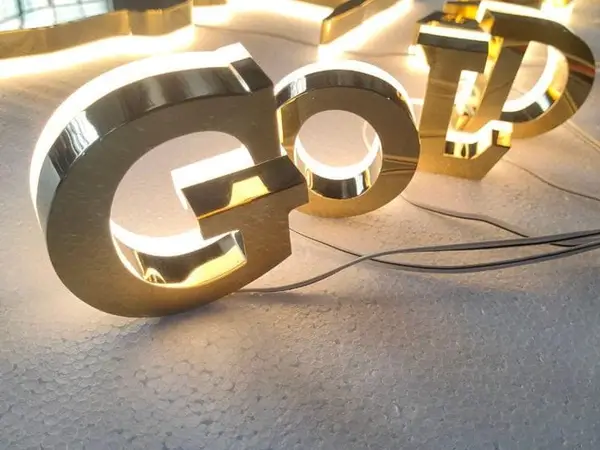
It’s 11pm and I just got off the phone with a sign shop owner who paid $8,000 for 40 trim cap letters from a factory that promised “perfect quality.” The acrylic faces popped out on the first 90-degree day. He called to vent, and I told him the same thing I’m telling you now: the problem wasn’t the trim cap itself. It was everything else he didn’t know to check.
Trim cap letters are the workhorse of
storefront signage. You’ve got an acrylic face, a metal return, a back panel, and a strip of extruded plastic that holds the face to the return. Sounds simple. It’s not.
What Are Trim Cap Letters?
If you’re ordering
front-lit channel letters for a storefront, you’re almost certainly getting trim cap construction. The trim cap is a flexible PVC extrusion that grips the edge of the acrylic face and snaps over the metal return. Light from the LED modules behind the face passes through the acrylic—quality acrylic lets 90–92% of that light through. The trim cap itself doesn’t illuminate—it just holds everything together.
The beauty of trim cap is that you can replace the acrylic face without rebuilding the whole letter. Face cracked by a rock? Pop off the old trim cap, slide in a new face, snap on new trim cap. Done. No welding, no repainting, no rewiring. That’s why service shops love them.
But here’s where it gets ugly: cheap trim caps aren’t made to the same tolerance as the good stuff. And if your return metal wasn’t bent precisely, that trim cap will fight you every inch. I’ve watched guys spend an hour with a heat gun and a bottle of silicone spray just trying to seat one face.
Material Selection: Acrylic Face, Trim Cap Profile, Returns, and Backs
Here’s what nobody tells you: The acrylic face is the most important part of the whole damn letter, and it’s the first place factories cut corners. Domestic acrylic starts yellowing in 1-2 years. Imported UV-resistant acrylic from Mitsubishi or Degussa lasts 5-8 years. Guess which one most cheap Chinese factories use unless you specifically call it out.
For thickness, 2mm and 3mm are the most common. Over 2.5 meters in height, you need 5mm or the face will bow like a potato chip. I’ve seen 4-foot-tall letters with 2mm faces and no center support—looked like they were melting in the sun. Pay the extra for 3mm. It costs maybe 40% more but only cuts light output from 90% to 92%. Your customer won’t notice the 2% difference, but they’ll notice the face staying flat for a decade.
The metal return is usually aluminum or stainless steel. Aluminum weighs a third of steel and lasts 8-12 years outdoors. Stainless 304 lasts 10+ years, and 316 with 2-3% molybdenum lasts 15+ years in marine environments. If you’re building letters with stainless returns, make sure your supplier is using real
304/316 stainless steel, not some mystery alloy. For a strip mall in Ohio, 304 is fine. For Miami Beach, pay the 20-30% premium for 316 or you’ll be replacing letters in three years.
The back panel can be the same metal as the return or a separate piece. Some guys use PVC backs to save weight, but that’s a mistake for
outdoor signs. Metal backs keep the letter rigid and give you a solid surface for mounting studs. Don’t cheap out on the back.
Manufacturing Tolerances and Quality Control
Look, I’ve measured trim caps from three different factories, all claiming the same spec. One was wider, one was narrower, one was a different wall thickness altogether. If your return was bent for one spec and you get another, you’re in for a long afternoon. Tolerance on the groove width is not a suggestion—it’s the difference between a face that snaps in and one that needs a rubber mallet.
Our laser cutting holds ±0.1mm. That’s the kind of precision that makes a return fit a trim cap perfectly, every time. We bend and weld with TIG, grind and polish, then run an 8-12 hour aging test on every single sign. 100% QC inspection. You’d be surprised how many factories skip the aging test because it adds a day to production. Bad move. They’d rather ship you a sign with a cold solder joint than find it themselves.
Certifications matter here. CE marking costs 20,000-50,000 RMB. UL 48 costs $4,000-15,000 and takes 4-9 months. Ask any factory claiming “CE certified” to show you the certificate with today’s date. Watch them sweat. Our
front-lit channel letters are built to UL and IP65 standards—not just promised, certified.
LED Lighting and Electrical Configuration
The ugly truth is that most trim cap letters die from cheap LED modules, not from the trim cap itself. The industry standard is SMD 2835, 100-150 lumens per watt. Buy from a quality supplier like Samsung, Osram, or Blueview and you’re getting 5+ years of real lifespan. Buy cheap stuff and those modules start failing at 12-18 months. When one module dies, the whole letter looks like it has a missing tooth.
Color temperature matters more than you think. For hospitality, warm white 3000-3500K. For corporate or retail, neutral 4000-5000K. For industrial or highway, cool 6000-6500K. Don’t mix color temps on the same sign. I’ve seen it—half warm, half cool. Looks like a ransom note at night.
Outdoor signs need IP65 minimum—that’s dust-tight and protected from water jets. For coastal, IP66. IP68 is submersible—you don’t need that unless your sign is going underwater. If you’re ordering
acrylic LED letters for exterior use, make sure the LED modules are IP65 rated or better. And remember: IP65 doesn’t mean hurricane-proof.
Now, if you want a premium look without visible trim cap, you might consider
back-lit halo letters. Those hide the LED behind the letter and light the wall, not the face. Different animal, but the LED quality still matters.
Design File Setup and Artwork Requirements
I’ve seen this go wrong: A client sends a logo with stroke widths thinner than a pencil, and the sign shop bends the return to match. That thin return can’t hold a trim cap properly, and the face pops out. Keep stroke widths fat enough—if it looks like it’ll be a problem, it will. Use vector files, outline your fonts, and don’t assume the factory can magically fix your low-res JPG.
For trim cap letters, you need to account for the trim cap lip. You cut the face slightly smaller than the outside of the return, but the trim cap covers that gap. If you’re doing it in-house, leave a few millimeters clearance on each side. If you’re sending to a factory, just send the outer dimensions and let them handle the compensation. Trust me, they’ve done it more times than you.
Installation, Structural Loads, and Mounting
If you’re using stainless steel returns and backs, remember that stainless is heavy—7.93 grams per cubic centimeter. A large
channel letter can weigh 20-40 pounds. Anchor your mounting studs into something solid. I’ve seen a windstorm rip letters off a building because the installer used drywall anchors instead of through-bolting into structure. That’s not a warranty claim—that’s a lawsuit.
Aluminum is a third the weight of steel, lasts 8-12 years outdoors, and is naturally rust-proof. For most storefronts, aluminum returns are perfectly fine and much easier to install. For coastal or high-traffic areas, stainless 316 is worth the premium. But don’t skimp on the mounting pattern—wind load is real, and a falling sign is your problem.
Cost Drivers and Factory-Direct Sourcing
Look, I’ve watched sign shops pay $800 for a
front-lit letter from a domestic fabricator. Same 304 stainless, same Samsung LEDs, same trim cap. We ship that letter for $120 factory-direct. That’s a 50-65% savings on product cost. You still pay shipping and tariffs, but you’re still way ahead.
Factory prices per letter:
front-lit channel letters run $20-80, back-lit halo $35-120, stainless non-lit $15-40. US retail installed prices are $200-700 per letter for front-lit and $400-1,000 for halo-lit. The gap is your margin—if you source smart.
Sea freight LCL runs $80-200 per cubic meter, and your crate passes through 6-8 pairs of hands between our dock and yours. Every touch is a chance for damage. US Section 301 tariffs on Chinese signs add about 30%. MOQ is 1 piece, lead time about 5-15 days. That’s not a typo—we do one-off custom letters in two weeks.
The common industry lie is that factory-direct means lower quality. That’s BS. Quality depends on the factory, not the country. A Chinese factory with CE, UL, 100% QC, and an 8-12 hour aging test will beat the pants off a domestic shop that still uses cheap domestic acrylic and no-name LEDs. The only way to know is to ask for the QC report, the LED module brand, and the acrylic brand. If they can’t tell you, walk away.
Do I really need 5mm acrylic for letters over 2.5 meters? Yes. 2mm will bow, 3mm might bow, 5mm won’t. I can’t believe I still have to explain this.
Why is my factory-direct quote so much cheaper than domestic? Because domestic shops mark up materials 300% and then add labor at $120/hour. We buy stainless by the ton and pay workers a fraction of that. It’s not rocket science.
Can I skip the aging test to save money? Only if you enjoy re-installing letters after one of the LED modules dies on day three. The aging test costs almost nothing and catches cold solder joints before they ship.
Is IP65 enough for outdoor? IP65 means dust-tight and protected from water jets. It does NOT mean hurricane-proof. If you’re in a coastal zone, go IP66. If your sign goes underwater, you need IP68, but then you have bigger problems.