I’ve unwrapped a $600 front-lit letter from a “premium” local fabricator and found LEDs you’d stick under a kitchen cabinet. The acrylic was already starting to pink at the edge, and the silicone seal looked like it was applied with a butter knife. That’s the day I stopped trusting catalogs and started trusting factory floors. Our floor, specifically—Aochuang Sign in Lu’an, Anhui. 3,000 square metres of dust, sparks, and 50-plus workers who’ve been bending stainless longer than some sign shop owners have been alive.
Here’s what nobody tells you: most of the illuminated letters hanging on American strip malls this morning were welded, wired, and tested in a Chinese factory like ours anyway. You just paid a middleman’s boat payment on top. We’ll ship those same letters to your loading dock—or directly to your client’s job site—for 50% to 65% less than US retail installed pricing. I’m not going to waste your time with fluff. If you want to know what to order, what to avoid, and exactly what happens when you cut the middleman, keep reading.
Look, I’ve done the math on the back of a bending template more times than I’ve called my wife to say I’m running late. A front-lit channel letter that costs us $45 in materials and labor leaves our dock at $60 to $80. That same letter, installed by a sign shop in Dallas or Denver, hits the client’s invoice at $350 to $500—sometimes $700 if it’s a high-visibility pylon.
The ugly truth is that US sign shops aren’t gouging you. They’ve got rent, insurance, union labor, and a truck that gets 12 miles to the gallon. What they’re doing is buying from a domestic wholesaler who bought from an importer who bought from a factory. By the time the letter reaches the installation crew, four parties have taken a cut. You can collapse that chain to one. You pay us, we build, you install. The savings don’t come from magic; they come from erasing layers of markup.
Here’s the catch, and I want you to hear it from me before your accountant finds out: Section 301 tariffs slap about 30% on top of the invoice value when your shipment clears US Customs. That $80 letter turns into $104. Still, your total landed cost—product + sea freight ($80-$200 per cubic metre LCL) + duty—rarely cracks half of what a domestic wholesaler charges you. If you order a full container (FCL), 25 to 40 cubic metres of signs, the freight per unit drops so low it’s almost funny. I’ve seen sign shop owners order one 20-foot container of front-lit channel letters and pay less than the raw acrylic sheet would cost them at local supplier rates.
I’ve seen this go wrong: a contractor installs beautiful 3mm acrylic letters on a south-facing wall in Phoenix. Eighteen months later, the letters look like they’ve been dipped in tea. The acrylic wasn’t UV-resistant. They saved $4 per letter on domestic sheet and spent $2,400 replacing the whole set. Don’t be that contractor. For anything that sees real sun, you specify Mitsubishi or Degussa acrylic—90% to 92% light transmittance, 5 to 8 years before any visible yellowing. Domestic Chinese acrylic? I’ll give it one to two years, then it starts to go. For faces over 2.5 metres tall, use 5mm thickness minimum. Anything thinner bows under its own weight once the sun heats it up.
Stainless steel is the workhorse of outdoor signage, but not all stainless is equal. 304-grade (18% chromium, 8% nickel) gives you a solid 10-year-plus outdoor life in most cities. We offer it in brushed #4, mirror #8, PVD, or powder coated. But if the sign’s going within five miles of saltwater—Miami, Galveston, Long Beach—you pay the 20% to 30% premium for 316 marine-grade with molybdenum. I’ve pulled a 304 letter off a coastal restaurant after three years that looked like a cheese grater. The 316 letter next to it was pristine. That extra $15 per letter buys a decade of not looking stupid. For interior or lightweight applications, aluminum letters are a third of the weight of steel, naturally rust-proof, and last 8 to 12 years outside with proper anodizing or powder coat.
Every factory brochure says “high-quality LEDs, 50,000-hour lifespan.” I’ve thrown away modules that failed at 18 months because some purchasing manager bought from the cheapest Shenzhen booth at a trade show. The L70 rating of a real LED module—Samsung, Osram, or Lan Jing chips—is genuinely 50,000 hours. That’s over 11 years of overnight operation. Cheap no-name SMD 2835 modules? They do 12 to 18 months before half the diodes in the letter are dim or dead. The cost difference is around $3 per metre of LED tape. On a set of 20 channel letters, you’re risking a client’s fury over sixty bucks. Our standard LED for back-lit halo letters and front-lit signs is SMD 2835 at 100-150 lumens per watt, colour temperature matched to your spec. Warm white 3000-3500K for hospitality, neutral 4000-5000K for corporate lobbies, and 6000-6500K cool white for highway pylons where you want your sign to punch through fog.
Here’s what nobody tells you: colour temperature shifts when you run LEDs hot. A sign with poor ventilation in a Phoenix summer will see 4000K drift toward 4300K after two years. We drill vent/drain holes in every letter, 3mm diameter minimum, to release heat and water. Many factories skip that because cutting a hole “ruins the clean look.” You know what else ruins a clean look? Three inches of condensation and a dozen dead LEDs.
I’ve had a customer wave a CE certificate dated 2013 and ask if we’re “real.” CE marking costs 20,000 to 50,000 RMB and takes a few weeks of testing. Tons of factories have one, but many let it expire or never update it when they change suppliers. Ask to see the certificate with today’s date, and check the product scope. If it doesn’t list illuminated signage, it’s worthless. Our factory holds ISO 9001, CE, and RoHS. For the US market, if your municipality requires UL 48 listing, understand it’s a monster: $4,000 to $15,000 in testing, 4 to 9 months of back-and-forth, and quarterly factory audits. We’re transparent about this: we don’t maintain an in-house UL file on every letter style because it would triple our lead time and add 25% to your cost. But we can build to UL-recognized components and work with a third-party ETL field inspection company—10% to 30% cheaper than UL—if your job demands it.
IP ratings are another place you can get lied to. IP65 means the enclosure is dust-tight and protected against water jets from any direction. That’s your minimum outdoor rating. IP66 adds powerful jet protection, good for coastal wind-driven rain. IP68 is submersible, which you’d need if you’re mounting signs in a hurricane zone on a boardwalk that floods. I’ve seen factories slap an IP65 sticker on a sign with a 2mm gap at the bottom where the face meets the return. If you’re ordering neon flex signs that live outdoors, ask for photos of the silicone end caps and a shot of the aging test in progress. A real 8-to-12-hour aging burn catches most early failures before they leave our floor.
Three thousand square metres sounds big until you realize half of it is raw material racks and finished goods crates waiting for a container. We’re not a mega-factory churning out 10,000 identical letters a week. We’re a specialist shop, 50-plus skilled workers, most of whom have been with us since 2010. Our MOQ is one piece. I mean that literally—if you need a single replacement letter for a tenant change, we do it. Lead time runs 7 to 15 days depending on complexity, from design confirmation to crating. The 10-step process is baked into muscle memory: laser cutting with ±0.1mm accuracy, TIG welding by guys who can lay a bead finer than a pencil line, grinding and polishing to mirror finish, CNC routing the acrylic face, assembling LEDs with thermal tape, sealing everything with neutral silicone that doesn’t eat the acrylic’s edge, then 8 to 12 hours of burn-in before 100% QC inspection.
We ship everything in custom foam-lined cartons inside plywood crates. I’ve received signs from other factories packed in newspaper and hopes. Ours arrive without a fingerprint on the face. For packaging, we add about 8% to material cost, and it’s the cheapest insurance you’ll ever buy. Sea freight from Shanghai to the US West Coast is about 65 days port-to-port. East Coast adds a Panama Canal transit bump. Express air (7 to 15 days) works for rush jobs, but costs $30 to $100 for a sample-sized parcel. For a full project, sea LCL at $80 to $200 per cubic metre is what makes the economics sing.
When you browse acrylic light boxes or food menu signs, you’re looking at the same production line. The light box above the counter at a fried chicken chain and the brushed aluminum lobby directory were both formed, welded, and lit under our roof. That cross-training means our crew doesn’t blink when you ask for a bizarre combination—say, a rimless channel letter with an acrylic push-through face and a backlit halo border. They’ve done weirder.
The ugly truth is that we’re a manufacturer, not a permitting consultant. We can’t tell you whether your landlord will approve a projecting sign over the sidewalk or whether the city requires a structural engineer’s stamp. We provide weight, wind-load calculations based on the shape, and material data sheets. The rest is on you or your local installer. I’ve seen contractors order $12,000 worth of stainless steel letters without checking the building’s mounting surface first—turns out it was EIFS over foam, no structural backing. Not our fault. Do your survey.
We also won’t rush UL certification for a 15-letter job and pretend it’s going to happen in a week. If your jurisdiction is strict, factor the third-party field inspection into your timeline and budget. We’ll build to the standard, use recognized power supplies and wiring methods, and label the sign accordingly. But if you need a sticker from an NRTL before the sign is energized, we need advance notice, not a panicked email three days before install.
On warranties: we stand behind 2 years on LEDs and 1 year on power supplies. That’s realistic because cheap drivers die first. We include Mean Well or equivalent IP-rated supplies as standard. I’ve seen fly-by-night factories offer “5-year warranty” and then vanish when the driver capacitor pops at 18 months. We’re still here, ISO certified, exporting worldwide. You’ll get a response within hours if a module fails, and we’ll ship replacements at our cost.
Look, I’ve handled RFQs scribbled on a napkin and ones that were 40-page PDFs with Pantone callouts. Both can work. Here’s what I need from you: accurate artwork (vector .ai or .dxf), overall dimensions, letter depth (typically 80mm for small front-lit, 120mm for halo), material choice, illumination type, colour temperature, and whether you need a dimmable driver. If you don’t know what to pick, send a photo of the building and I’ll tell you what I’d do if it were my money.
I’ve seen this go wrong: a sign shop owner orders halo-lit letters with warm white LEDs because it looks elegant in a dark workshop. Installed on a cream-coloured façade, the amber glow disappears into the stucco at sunset. I should’ve pushed back and suggested 4000K neutral white. Now I do, every time. I’ll question your choices if I see a failure about to happen. That’s not upselling; that’s me not wanting a crate of expensive scrap coming back on my conscience.
Reach out for a quote. I’ll drop factory prices into a spreadsheet, not some inflated “special offer” with a countdown timer. For rimless channel letters, you’re looking at a range that starts around $30 a letter for a basic 300mm-tall unit with front-lit face, moving up to $120 for a large dual-lit architectural statement piece. Dual-lit channel letters that glow white from the face and warm from the back cost more because you’re essentially building two illumination systems in one can. Brass letters? Those are luxury; we do them, but be prepared for a premium material cost. The point is, I’ll give you real numbers based on how much aluminium, acrylic, and LED our BOM (bill of materials) actually contains, plus labour at a rate we’ve been working with for 15 years. I’m not going to dazzle you with marketing. I’m going to send you CAD drawings, production photos, and a tracking number. The rest is just signs.

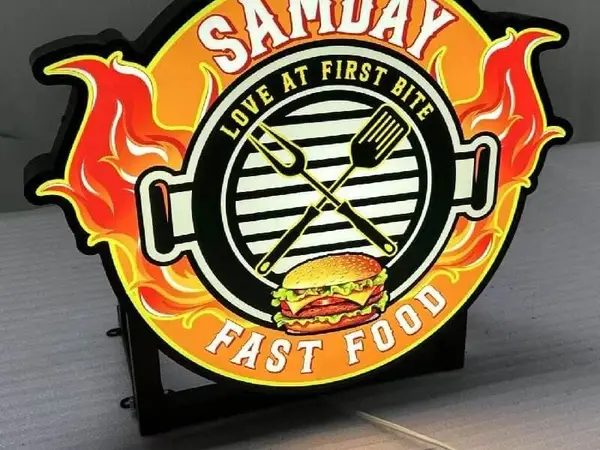
Real photo from our production floor — every sign we ship is made here.
From $24/letter · MOQ 1 piece · Flexible lead time · CE & UL certified · ships to 20+ countries
Custom sizes, colors, and finishes. Get a factory price in 24 hours.
Get a Free Quote Copy EmailWhatsApp +86 13865703472 · business@aochuangsign.cn
See pricing, specs, and get a free quote for the sign type you need. Built in our factory, shipped worldwide.