If you've ever had to pull a sign down because the acrylic turned yellow after 18 months, or watched the stainless steel start pitting around the edges, you know the real cost of cheap materials. I've been doing this since 2010, and I've seen the same mistake made by contractors, sign shops, and building owners. They pick a material based on a brochure or a low price, and then they're back in the loop within two years.
Here's the problem: most outdoor sign specs are written by salespeople, not engineers. They'll tell you "UV-resistant acrylic" and "marine-grade stainless" without telling you what those labels actually mean in the real world. A UV-resistant acrylic from Mitsubishi or Degussa lasts 5-8 years before yellowing. The same label on a domestic sheet? You're lucky to get 2 years. That's not opinion — that's the difference between a 92% light transmittance polymer and a 70% filler blend.
I run a factory in Lu'an, Anhui. We've shipped worldwide. I've watched sign shops pay $800 for a front-lit letter from a domestic fabricator. Same 304 stainless, same Samsung LEDs. We ship that letter for $120. The difference isn't just labor — it's knowing exactly which material grade works for which climate. Let me break this down: there is no single "best" material for outdoor business signs. But there are materials that will kill your reputation if you choose wrong.
Most buyers don't realize that "acrylic" is a category, not a specification. You've got cast acrylic, extruded acrylic, and the cheap imported stuff that barely qualifies as plastic. Our shop uses Mitsubishi or Degussa sheets with 90-92% light transmittance and UV stabilizers built in. That's what gives you a clean, bright front-lit sign for half a decade. But if you buy from a distributor who sources 3mm domestic acrylic, you'll see the yellowing start around month 14. It's not gradual — it's like someone turned a dimmer switch on your sign.
The spec says … but in reality, the 5-8 year UV-resistant claim only holds if the sheet meets ISO 4892-2 weathering test standards. Most Chinese domestic acrylic doesn't. They use recycled PMMA with less UV absorber. I've tested both side-by-side under accelerated UV. The domestic sheet lost 30% of its light transmittance in 1,000 hours. The Mitsubishi sheet dropped 4%. That's the difference between a sign that looks new after 5 years and one that looks like old Tupperware after 18 months.
Here's a hard rule you can use: if your sign face is over 2.5 meters tall, you need 5mm acrylic minimum. Anything thinner and the wind load will bow it, crack it, or pop the letter gaskets. I've seen 3mm letters on a storefront in a wind tunnel effect between two buildings — they looked like a closing accordion. The fabricator saved $15 on material and cost the client $700 in emergency replacement.
And one brutal honesty moment: "UV-resistant" does not mean "won't yellow." It means the yellowing is slowed down. If your sign faces direct south exposure in Arizona or Texas, even the best acrylic will show some color shift after 5 years. Plan for a face replacement. That's honest — you won't hear that from a sales rep.
I've argued with more project managers about stainless steel grades than anything else. They see "stainless" and assume it's bulletproof. Here's the math: 304 stainless has 18% chromium and 8% nickel. That's good for most inland environments — 10+ years outdoor life if you keep it clean. But 316 adds 2-3% molybdenum, which fights chloride attack. If your sign is within 3 miles of saltwater, or in an industrial area with chemical fumes, 304 will start pitting in 3-4 years. 316 will last 15+.
Let me break this down: the cost premium for 316 is 20-30% over 304. For a strip mall in Ohio, 304 is fine. For Miami Beach, pay for 316 or you're replacing letters in 3 years. I've got a client in Charleston who ignored this. They used 304 letters on a 20-foot storefront facing the harbor. By year two, the edges were rough with red rust. They had to pull every letter, sandblast, and refinish — cost them $4,000. The upgrade to 316 would have been $600 extra on the original order.
The common finishes: brushed #4, mirror #8, PVD, and powder coated. Brushed #4 hides scratches better. Mirror #8 shows every fingerprint and needs regular maintenance. Powder coating adds a layer of protection, but if the coating chips, moisture gets under it and you get localized rust. For outdoor coastal, I recommend brushed #4 with a clear powder coat — but only if the prep work includes a proper acid wash. Most cheap shops skip the wash and just spray. The coating delaminates in 2 years.
Quick way to spot bad stainless fabrication: look at the welds. TIG welding with the right filler rod should be smooth and uniform. If you see gray or black discoloration around the weld, that's oxidation — the heat wasn't controlled, and the corrosion resistance is shot in that zone. A good shop will passivate the entire piece after welding to restore the chromium oxide layer. Most don't. They grind it down and call it done. That weld zone will rust first.
Aluminum gets overlooked for business signs because people think it's too soft. But it's one-third the weight of steel, naturally rust-proof (no iron to oxidize), and with a proper anodized finish it can last 8-12 years outdoors. We use 0.040-0.063" (1.0-1.6mm) sheet for most channel letter backs and trim. Thicker for large monolithic signs.
The trap with aluminum is the finishing. Bare aluminum develops a thin oxide layer that protects it — but that layer is dull gray and porous. Dirt sticks, and in marine environments, salt can pit it. Anodizing adds a hard, clear, or colored oxide layer that's bonded to the metal. It's not a coating — it's a conversion. That's why anodized aluminum keeps its look for years. Powder coating over bare aluminum? The coating is only as good as the adhesion primer. If the shop doesn't etch the surface properly, the powder coat peels off in sheets.
Most buyers don't realize that aluminum signs almost always need a backplate or internal bracing. The material can flex under wind load if the sign is larger than about 4 feet. I've seen a 6-foot aluminum sign in a thunderstorm bounce like a trampoline. The letters stayed attached, but the backplate buckled. Cost the client $1,200 to re-frame. A proper design adds internal gussets or a thicker gauge. It adds maybe $30 to the fabrication. Thirty dollars saves a sign.
Every LED module says it's 50,000 hours. That's the L70 spec — time to reach 70% of initial brightness. But that's tested at 25°C in a lab. In a sealed outdoor sign in July, the internal temperature can hit 70°C. At that temp, the L70 for cheap modules drops to 12-18 months. Quality modules using Samsung or Osram chips (like the SMD 2835 or 5050) actually hit 50,000 hours because they're designed for higher thermal resistance. We Lan Jing modules with SMD 2835, 100-150 lumens per watt.
They cost more, but we've had signs running 6 years without a single failure.
Quickest way to spot bad LED modules: look at the solder joints. Dull gray = won't last 18 months. Shiny silver = proper lead-free solder with rosin flux. I've opened modules from cheap factories and seen joints that look like cold solder — dull, cracked, barely attached. Those fail within weeks. We run an 8-12 hour aging test on every sign before it ships. If an LED fails during test, we replace the entire module, not just the chip. That's not standard. It should be.
Color temperature matters for outdoor signs. 3000-3500K warm for hospitality — restaurants, bars. 4000-5000K neutral for corporate and retail. 6000-6500K cool for industrial and highway. But here's the thing: cheap LEDs drift color. A 5000K module might look 5500K after a year. We use only bin-matched LEDs from the same production batch. If you see color variation between letters on a sign, that's the binning problem. And it's permanent.
IP65 sounds impressive. It means dust-tight and protected against water jets from any direction. It does NOT mean your sign survives a Florida hurricane. I've seen IP65-rated letters fill with water after a tropical storm because the gasket material wasn't rated for sustained pressure washing from wind-driven rain. For coastal areas, you need IP66 minimum — powerful water jets. For submerged applications, IP68. But even IP68 does not guarantee the seal holds under thermal cycling. Silicone expands and contracts.
If you use cheap neutral-cure silicone, it hardens and cracks in 2 years. We use Dow Corning 795 — it stays flexible and bonds to acrylic, metal, and glass.
The spec says … but in reality, every sign has a weak point: the entry hole for the wiring. If that hole isn't sealed with a proper gland or potted, water wicks along the wire right into the letter. I've cut open "waterproof" signs with mold growing inside the acrylic. The installer left a 1/4-inch gap around the wire. An IP65-rated module doesn't help when the whole housing is flooded.
Let me break this down: the IEC 60529 test for IP65 is done with fresh water at 30 kPa from a 6.3mm nozzle. That's a garden hose. A hurricane drives water at 200+ kPa mixed with sand and salt. That's not in the certification. For real outdoor durability, you need a factory that adds a secondary seal — a bead of silicone around every joint, not just the gasket. We do that on every sign over 24 inches. It costs us $5 in material per letter. The insurance claim on a damaged sign? $2,000 minimum.

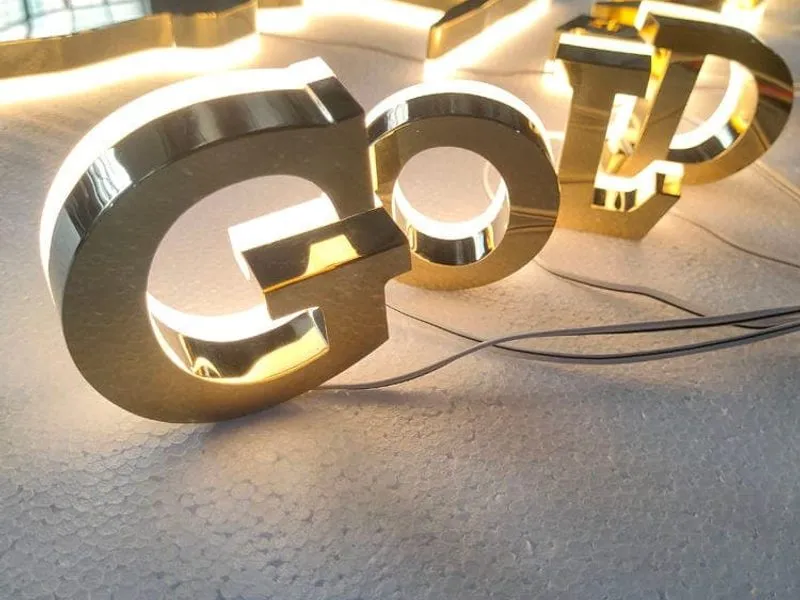
Real photo from our production floor — every sign we ship is made here.
Products mentioned or relevant to this topic — factory-direct, custom built.
From $24/letter · MOQ 1 piece · Flexible lead time · Project-specific compliance documents · ships to 20+ countries
Custom sizes, colors, and finishes. Get a factory price in 24 hours.
Get a Free Quote Copy EmailWhatsApp +86 13865703472 · business@aochuangsign.cn
See pricing, specs, and get a free quote for the sign type you need. Built in our factory, shipped worldwide.