Here's what nobody tells you: the sign you put up today has about five years before you'll be asked to replace it, and the material you pick now decides whether that's a victory lap or a cash fire.
I've run a sign factory in Lu'an, Anhui since 2010. We've shipped channel letters worldwide. I've watched importers order 304 stainless from us, and I've watched sign shops buy "stainless" from a broker that turned out to be painted iron. This guide is the one I'd give you across a table, not some polished brochure.
Stainless vs aluminum. Both have a place. But they're not interchangeable, and your customer's location, budget, and expectations will call the shot.
Stainless 304 is the workhorse. 18% chromium, 8% nickel. Ten-plus years outdoors, and that's with salt in the air, not just parking lot dust. 316 adds 2-3% molybdenum, pushes that to 15+ years. It's the only answer for coastal or industrial environments. Sorry, that's not me being picky — it's chemistry.
Aluminum gets 8-12 years outside. It's a third of the weight of steel. Naturally rust-proof — it oxidizes on the surface and protects itself. But "rust-proof" doesn't mean "dent-proof". A 1.0mm aluminum letter will deform if a ladder leans on it. A 1.5mm stainless letter shrugs it off.
The ugly truth is that most sign shops don't think about metal thickness. They buy the cheapest 1.0mm stainless, then wonder why it warps over a 2-meter span. For anything over 2.5 meters, you're at 5mm acrylic on the face and at least 1.2mm metal on the returns. Our stainless steel letters start at 1.0mm but we won't quote 1.0mm for long runs. You'll thank me.
Now, LED life. That's the other half of the durability equation. SMD 2835 modules run 100-150 lumens per watt, and quality parts (Samsung, Osram, or Blueview) hold L70 for 50,000 hours. That's 5+ years real life. Cheap modules? Twelve to eighteen months, and then you're on a lift replacing them with the customer's foot tapping.
I've seen this go wrong: a shop buys "stainless steel letters with premium LEDs" from a middleman. They get 0.8mm stainless — which is really just tin can with polish — and LEDs that flicker after a year. Then they call us for a replacement. Don't be that shop.
Here's the part that makes importers happy and local fabricators nervous. Factory prices per letter, straight from our floor:
A US fabricator will quote you $200–700 per letter for the same front-lit spec. That's not a typo. But before you jump on a plane, remember the rest: shipping, tariffs, lead time. Express for small boxes is $30–100, 7–15 days. Air freight is $4–12 per kilo. Sea is $80–200 per cubic meter LCL, 50–70 days. And the US Section 301 tariff on Chinese signage? Around 30%. Do that math on a $40 letter and it's still a steal, but it's not zero.
Let me give you a mini-story. A contractor from Texas ordered 40 front-lit stainless letters from us. Sticker price: $2,400. Add air freight $680. Tariff $720. Total landed: $3,800. A US fabricator's quote was $14,000. He still saved 73%, and he got CE-certified, RoHS-compliant product. But if he'd gone with sea freight, he'd have saved another $400 and waited two months instead of twelve days.
The factory-direct savings are 50–65%. Don't expect 80% unless you're shipping a container and accepting the longer lead. We're honest about that because we don't want you to blow your deadline.
Stainless 304 can be brushed (#4, that's the standard satin look), mirror (#8, fancy but fingerprints show), PVD, or powder coated. PVD gives you gold, bronze, black — but it scratches like a car's clear coat if you're not careful. Powder coating on stainless is a waste of powder. The whole point of stainless is that it doesn't need paint. Leave it bare.
Aluminum gets anodized, powder coated, or brushed. Anodizing is a hard oxide layer — you can do dark bronze or black. Powder coating comes in any color, but it chips. And once it chips, it's a pathway for corrosion if the aluminum wasn't pre-treated right. We do it properly; some factories don't.
For signage, I'd say this: if your customer wants that premium architectural look, go with back-lit halo letters in stainless. The halo glow against a stainless face is a statement. Aluminum doesn't have the same presence.
Use stainless when the sign has to last a decade or more, especially in coastal, high-humidity, or industrial zones. 316 stainless for anywhere near saltwater. Full stop. I don't care if it's 20–30% more than 304. In Miami Beach, a sign made with 304 will show tea-staining within three years. 316 won't.
Also use stainless for structural supports, even if the faces are aluminum. The mounting brackets bear the load. Aluminum brackets will flex in a windstorm. Our dual-lit channel letters often use stainless frames for the mounting, aluminum returns for the letters — a hybrid that balances cost and strength.
One more: interior signs with a premium feel. Stainless has a weight and a sound when you tap it. Aluminum sounds... hollower. Customers notice that.
Aluminum wins on budget and logistics. If your project is a 3-year lease, a strip mall in a dry climate, or a big light box that's getting replaced in a refresh, aluminum is smart. It's also the only way to get a truly rust-proof sign at a low weight. Our aluminum letters are $10–25 per letter. For a storefront with 12 letters, that's a couple hundred dollars. Not $8,000.
Aluminum is also easier to fabricate into complex shapes. CNC routing, bending, welding — all doable. You can make a 3D fabricated letter in aluminum at $40–120, versus stainless at the same or higher with more welding time. If the design calls for multiple layers and depth, aluminum gets my vote. We also build acrylic light boxes with aluminum frames for a thousand reasons; they don't rust and they don't weigh your wall down.
But here's the line: don't put aluminum letters where you need LED RGB and expect them to last in direct sun for a decade. The LEDs will fail before the metal does. That's another reason to budget for quality modules, not just the housing. And if you need a modern neon look, our neon flex signs are PVC and LED — not aluminum — but they're lightweight and cheap for interior promo.
Everyone claims CE. CE marking costs 20,000–50,000 RMB and takes 2–8 weeks. Many factories print it without the certificate. Ask to see the actual certificate with today's date. We have CE, RoHS, and ISO 9001. We don't have UL 48, and we'll tell you that upfront. UL is $4,000–15,000 and takes 4–9 months with quarterly audits. For most export orders, CE plus the NEC Article 600 requirement for US electrical is enough. If your customer's insurance demands UL, we can't be your factory for that. Find a domestic assembler to finish the UL work. No point lying about it.
IP ratings? IP65 is dust-tight and water jets from any direction. That's the minimum for outdoor. IP66 for powerful jets — coastal. IP68 is submersible. We recommend IP65 for most channel letters, IP66 for coastal. And no rating stops a hurricane. I've seen IP65 signs in Florida ripped off a facade because the mounts weren't stainless. The sign itself was fine. The mounting failed.
Here's what nobody tells you: a sign's lifespan is only as good as its weakest seal. We use neutral silicone on every joint. Not cheap acrylic adhesive. Not caulk. Neutral silicone. That's a one-day step in our 10-step process. If someone quotes you a 5-day lead, they're skipping that cure.
We're a 3,000-square-meter shop with 50+ skilled workers. We've exported to 21
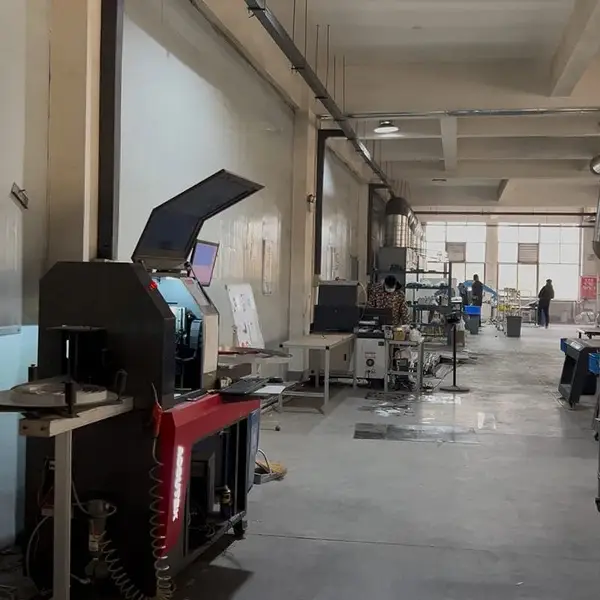
Real photo from our production floor — every sign we ship is made here.
Products mentioned or relevant to this topic — factory-direct, custom built.
Factory-direct since 2010. Free quote within 24 hours — no obligation.
Get a Free Quote → Copy EmailMOQ: 1 piece · Flexible lead time · 2-year warranty · Worldwide shipping
See pricing, specs, and get a free quote for the sign type you need. Built in our factory, shipped worldwide.