I’ve watched more sign shops get burned by a bad supplier than I’ve seen broken channel letters. And I’ve seen a lot of broken channel letters.
Twenty years in the field, thirty‑plus states, and a thousand installations later, I can spot a fraud from the first email. The guy with the slick website and no shop address? Run. The one who promises UL listing in two weeks? He’s lying. The factory that quotes $20 a letter but won’t say what LEDs they use? That letter will be a brown mess inside a year.
You’re not buying a sign. You’re buying a reputation. Every sign you install — every letter that flickers, every face that yellows, every power supply that hums and dies — that failure lands on your doorstep. The end customer doesn’t blame the factory in China. They blame you.
So here’s what I’ve learned, paid for in my own time and money, about finding a wholesale LED sign supplier who won’t screw you.
Pro tip: Most small Chinese factories don’t hold a real UL listing. Because UL 48 costs $4,000 to $15,000 and takes 4 to 9 months. Plus quarterly audits. So they do one of three things: lie, buy a counterfeit sticker, or slap “UL Compliant” on the invoice. I’ve seen all three.
Here’s what the permit office won’t tell you: If your sign says UL on it and an inspector finds it’s fake, you’re ripping that sign off the wall. At your cost. I watched a shop in Houston lose a $12,000 job because the “UL” letters were counterfeit. The inspector knew the font was wrong. Seriously.
If the factory says they have UL, ask for the UL file number. Then call UL (they actually have a verification line). Most factories will go silent. I’ve had four different suppliers in Shenzhen claim UL — zero could produce a live number.
ETL is a real alternative. It costs 10–30% less than UL and takes about the same time if the factory has their act together. But still, verify. Don’t make the mistake I made: I once accepted a photo of a certificate. Looked legit. Turned out the cert number belonged to a toaster factory in Ohio. The sign never made it past the first inspection.
CE marking? It costs 20,000–50,000 RMB and some factories just print the logo. Ask to see the certificate — with today’s date and the factory’s exact name. Watch them sweat.
I've installed this in Miami, in Cleveland, in Phoenix. The difference between a letter that lasts 8 years and one that crumbles in 2 is often just the acrylic.
Real UV‑resistant acrylic — Mitsubishi or Degussa — holds 90–92% light transmittance for 5–8 years. Domestic acrylic? You get 1–2 years before it turns yellow like a smoker’s teeth. I pulled a set of letters off a bank in Tulsa after 18 months. The front faces were so yellow the daytime look was “butter.” The customer wanted a refund. I ate that job.
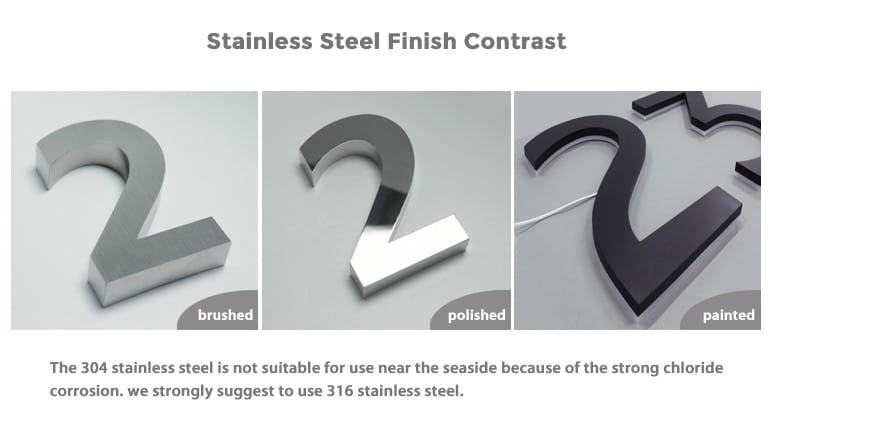
Same story with stainless steel. 304 is fine for most inland jobs — 10+ years outdoor, 18% chromium, 8% nickel. But 316 marine grade costs 20–30% more and includes 2–3% molybdenum. For a strip mall in Ohio, use 304. For Miami Beach, pay for 316 or you’re replacing letters in 3 years. I learned that one on a hotel job in Galveston. Salt air ate through the 304 in 26 months. It wasn’t rust, it was pitting. Microscopic holes. Looked awful.
Aluminum is one‑third the weight of steel. 8–12 year outdoor life if powder coated right. But if they use 0.040″ gauge when you need 0.063″ for a letter over 2.5 meters? It’ll flex in wind. I saw a three‑foot “COFFEE” sign in Denver wobble like a drunk. Had to gusset every mounting tab.
Quickest way to spot bad LED modules: look at the solder joints. Dull gray means they used cheap flux and low‑temperature solder. That won’t last 18 months. Shiny silver indicates proper lead‑free solder. I carry a jeweler’s loupe in my truck. No joke. I’ve rejected entire pallets because the solder looked like mud.
SMD 2835 is the industry workhorse — 100–150 lm/W. SMD 5730 gives you 40–60 lm per chip, brighter but hotter. The modules that actually last 5 years use Samsung, Osram, or a Chinese brand Lan Jing. The cheap ones — no brand, no datasheet — they’ll give you 12–18 months tops. And the color shift is brutal. I had a client with a two‑year‑old sign where half the letters were 6500K and half were 4500K. Looked like a hybrid car.
I've watched sign shops pay $800 for a front‑lit letter from a domestic fabricator. Same 304 stainless, same Samsung LEDs. We ship that letter for $120. Factory‑direct savings are 50–65% on the product itself. That’s real.
But you don’t just compare unit prices. You add shipping, tariffs, customs clearance, and the risk of damage.
Express shipping (DHL, FedEx) for small orders: $30–100 per shipment, 7-10 days. Air freight for larger orders: $4–12 per kg, about 10 days. Sea freight for full pallets: $80–200 per cubic meter LCL, or $1,200–3,000 for a full container, about 65 days.
And then there’s the US Section 301 tariff — roughly 30% on Chinese‑origin signs. Some factories under‑declare, some use different HS codes. Don’t let them. Customs seizes the goods, and you’re explaining to your customer why their sign is stuck in a bonded warehouse.
Real math: a 10‑letter front‑lit channel letter set from a Chinese supplier — $120 per letter = $1,200. Sea freight for a crate about 1.5 m³ = $150. Tariff 30% of $1,200 = $360. Customs brokerage = $200. Total delivered cost = $1,910. That’s $191 per letter. Domestic fabrication for the same spec? $400–700 per letter. You save over $200 per letter even after all the hassle. That’s worth some phone calls.
Don’t make the mistake I made: I once quoted a job based on the factory invoice price alone. Forgot the tariff. Lost $300 on that deal. Never again.
Any factory can slap together letters. A reliable supplier has a consistent 10‑step process and can walk you through it.
1. Design confirmation — 1 day. They should give you a DXF or AI file to check. If they skip this, you’re getting random sizes.
2. Laser cutting — ±0.1mm tolerance. Takes 1–2 days for most jobs.
3. Bending/welding — TIG welded, not just crimped. Look for photos of the weld line. Smooth = skilled labor.
4. Grinding/polishing — 1–2 days. The back of the letter should feel as smooth as the front.
5. Acrylic face CNC routing — 1 day. The face should fit the return within 1mm.
6. LED assembly — 1–2 days. They should test every module before mounting.
7. Sealing with neutral silicone — 1 day. Neutral cure, not acid cure. Acid corrodes aluminum returns over time.
8. Aging test — 8–12 hours. They run the sign at full brightness in a room. Burn‑in catches duds.
9. 100% QC inspection — every sign, every module. Not a random sample.
10. Export packaging — foam + carton + plywood crate. The crate should have corner braces and a moisture barrier.
If a factory can’t tell you their cycle time for each step, they don't have a system. They’re winging it. And your sign will show up late, bent, or dead.
I’ve visited a factory in Lu’an, Anhui — Aochuang Sign. 3,000 m² shop, 50‑plus workers, founded 2010. They walk you through every step. They’ve got the CE, RoHS, ISO 9001 certs (real ones, I checked). MOQ is 1 piece. Lead time 7–15 days. 2‑year warranty on LEDs, 1 year on power supply. That’s the kind of supplier you want.
IP65 sounds impressive. It means dust‑tight and protected against water jets from any direction. It does not mean your sign survives a Florida hurricane. Or even a bad thunderstorm. I’ve seen IP65 channel letters that water got into because the seam wasn’t sealed properly. The silicone failed at the bottom edge. If the factory doesn’t use a bead of neutral silicone on every interior seam, you’ll get corrosion inside a year.
LCL sea freight: your crate gets handled 6–8 times between our dock and yours. Every touch is a chance for damage. That’s not in the brochure. I once had a crate that looked like it was used for soccer practice. Two letters had dents. One was split open. The factory repacked it poorly. I had to get a local fabricator to re‑make those letters. Lost the profit on that job.
Always pay for plywood crating with corner protectors and a “this end up” sticker. Insist on photos of the packed crate before it ships. I’ve made it a standard spec: “Plywood crate, minimum 12mm thickness, with interior foam supports for each letter.” If the supplier balks, find another.
316 stainless costs 20–30% more than 304. For a strip mall in Ohio, 304 is fine. For Miami Beach, pay for 316 or you’re replacing letters in 3 years. I know I said that already, but I see it all the time and it makes me angry.
Here’s what the permit office won’t tell you: they don’t check every sign. But when they do, they want a UL or ETL label on the sign itself. A sticker in the box doesn’t count. Must be affixed to the back of the letter or inside the lightbox.
ADA compliance is a separate beast. Tactile letters need Grade 2 Braille, non‑glare finish, and mounting height between 48″ and 60″. If your wholesale supplier doesn’t offer ADA packages, you’re making them yourself or subbing out. That’s fine, but know it before you place the order.
NEC Article 600 governs sign installations in the US. It requires a disconnect within sight of the sign. Your supplier’s job ends at the sign. Your job includes the wiring. Don’t assume their terminating block matches US code. I’ve had to replace Chinese terminal strips with Wagos more times than I can count.
IP66 vs IP68? IP66 handles powerful water jets — that’s for coastal areas. IP68 is submersible — for fountains or flood zones. I’ve only used IP68 once, for a sign on a pier in Charleston. Overkill? Maybe. But it survived the last hurricane.
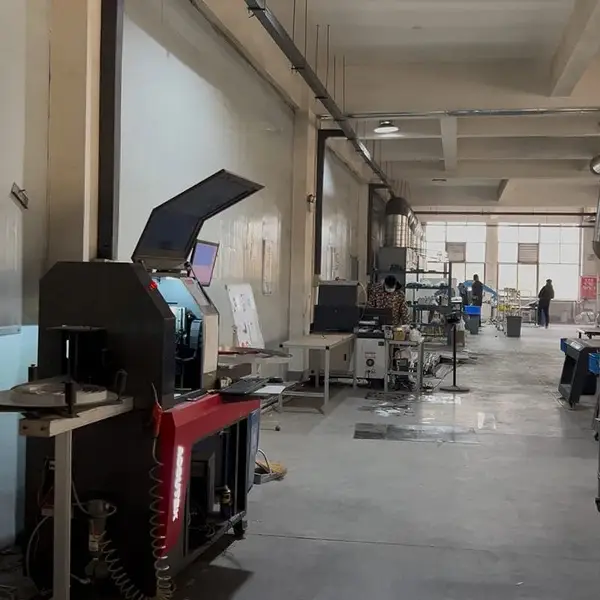
Real photo from our production floor — every sign we ship is made here.
Products mentioned or relevant to this topic — factory-direct, custom built.
From $24/letter · MOQ 1 piece · Flexible lead time · Project-specific compliance documents · ships to 20+ countries
Custom sizes, colors, and finishes. Get a factory price in 24 hours.
Get a Free Quote Copy EmailWhatsApp +86 13865703472 · business@aochuangsign.cn
See pricing, specs, and get a free quote for the sign type you need. Built in our factory, shipped worldwide.